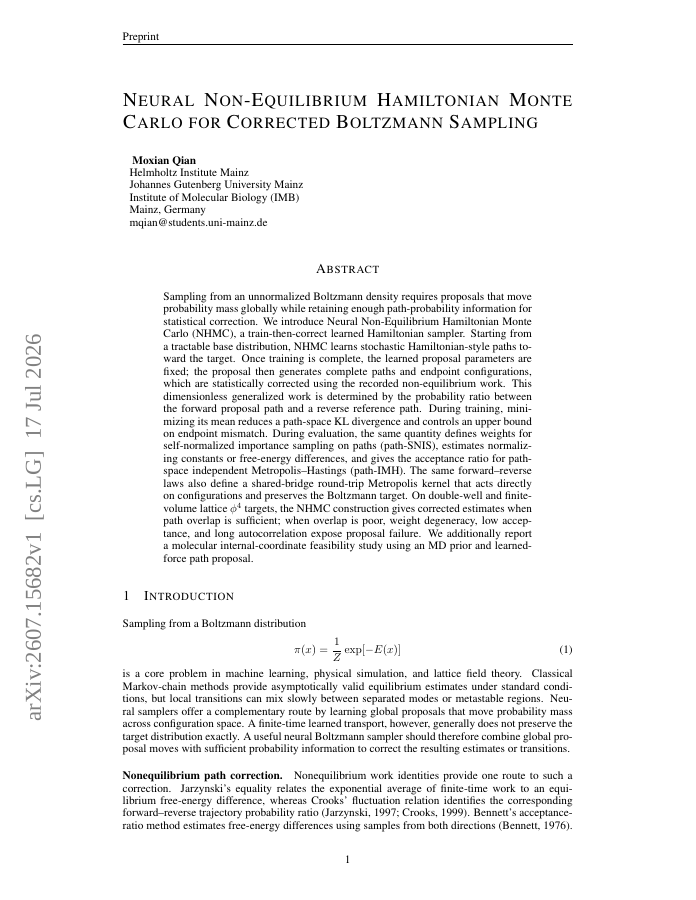
Sampling from an unnormalized Boltzmann density requires proposals that move probability mass globally while retaining enough path-probability information for statistical correction. We introduce Neural Non-Equilibrium Hamiltonian Monte Carlo (NHMC), a train-then-correct learned Hamiltonian sampler. Starting from a tractable base distribution, NHMC learns stochastic Hamiltonian-style paths toward the target. Once training is complete, the learned proposal parameters are fixed; the proposal then generates complete paths and endpoint configurations, which are statistically corrected using the recorded non-equilibrium work. This dimensionless generalized work is determined by the probability ratio between the forward proposal path and a reverse reference path. During training, minimizing its mean reduces a path-space KL divergence and controls an upper bound on endpoint mismatch. During evaluation, the same quantity defines weights for self-normalized importance sampling on paths (path-SNIS), estimates normalizing constants or free-energy differences, and gives the acceptance ratio for path-space independent Metropolis-Hastings (path-IMH). The same forward-reverse laws also define a shared-bridge round-trip Metropolis kernel that acts directly on configurations and preserves the Boltzmann target. On double-well and finite-volume lattice ϕ^4 targets, the NHMC construction gives corrected estimates when path overlap is sufficient; when overlap is poor, weight degeneracy, low acceptance, and long autocorrelation expose proposal failure. We additionally report a molecular internal-coordinate feasibility study using an MD prior and learned-force path proposal.
Neural Non-Equilibrium Hamiltonian Monte Carlo for Corrected Boltzmann Sampling
Sampling from an unnormalized Boltzmann density requires proposals that move probability mass globally while retaining enough path-probability information for statistical correction.
- Preview
- Year
- 2026
- Hosting
- Abstract onlyARXIV-DEFAULT
Cite
Notes
Only stored in your browser.
Attribution
- Abstract & full text
- arxiv.org/abs/2607.15682ARXIV-DEFAULT
- TL;DR
- Semantic Scholar