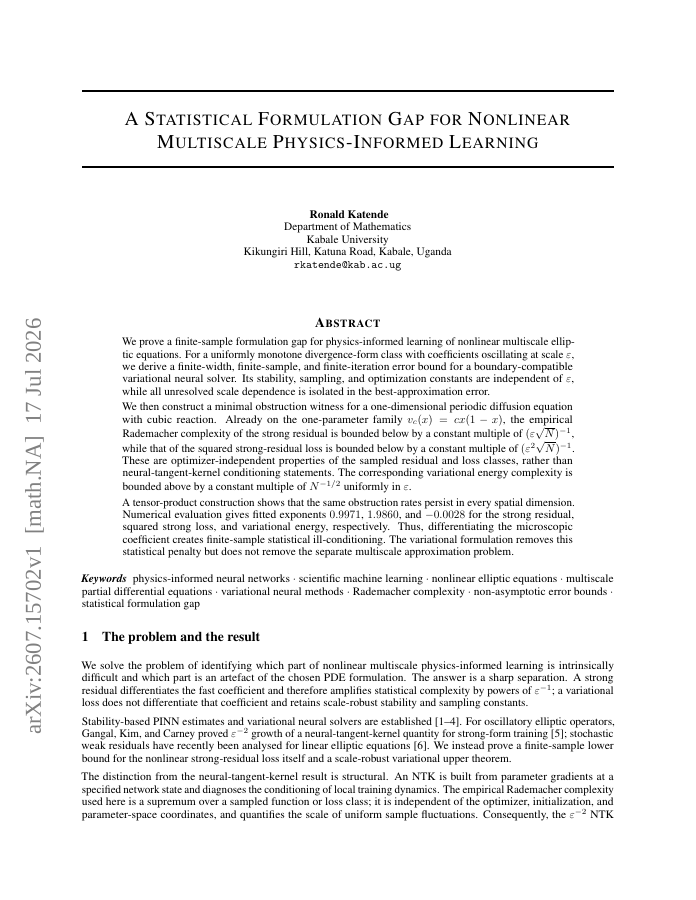
We prove a finite-sample formulation gap for physics-informed learning of nonlinear multiscale elliptic equations. For a uniformly monotone divergence-form class with coefficients oscillating at scale ε, we derive a finite-width, finite-sample, and finite-iteration error bound for a boundary-compatible variational neural solver. Its stability, sampling, and optimization constants are independent of ε, while all unresolved scale dependence is isolated in the best-approximation error. We then construct a minimal obstruction witness for a one-dimensional periodic diffusion equation with cubic reaction. Already on the one-parameter family v_c(x)=cx(1-x), the empirical Rademacher complexity of the strong residual is bounded below by a constant multiple of (ε\sqrt{N})^{-1}, while that of the squared strong-residual loss is bounded below by a constant multiple of (ε^2\sqrt{N})^{-1}. These are optimizer-independent properties of the sampled residual and loss classes, rather than neural-tangent-kernel conditioning statements. The corresponding variational energy complexity is bounded above by a constant multiple of N^{-1/2} uniformly in ε. A tensor-product construction shows that the same obstruction rates persist in every spatial dimension. Numerical evaluation gives fitted exponents 0.9971, 1.9860, and -0.0028 for the strong residual, squared strong loss, and variational energy, respectively. Thus, differentiating the microscopic coefficient creates finite-sample statistical ill-conditioning. The variational formulation removes this statistical penalty but does not remove the separate multiscale approximation problem.
A Statistical Formulation Gap for Nonlinear Multiscale Physics-Informed Learning
We prove a finite-sample formulation gap for physics-informed learning of nonlinear multiscale elliptic equations. For a uniformly monotone divergence-form class with coefficients oscillating at scale $ε$, we derive a finite-width, finite-sample, and finite-iteration error bound…
- Preview
- Year
- 2026
- Hosting
- Full text hostedCC-BY-4.0
Cite
Notes
Only stored in your browser.
Attribution
- Abstract & full text
- arxiv.org/abs/2607.15702CC-BY-4.0
- TL;DR
- Semantic Scholar