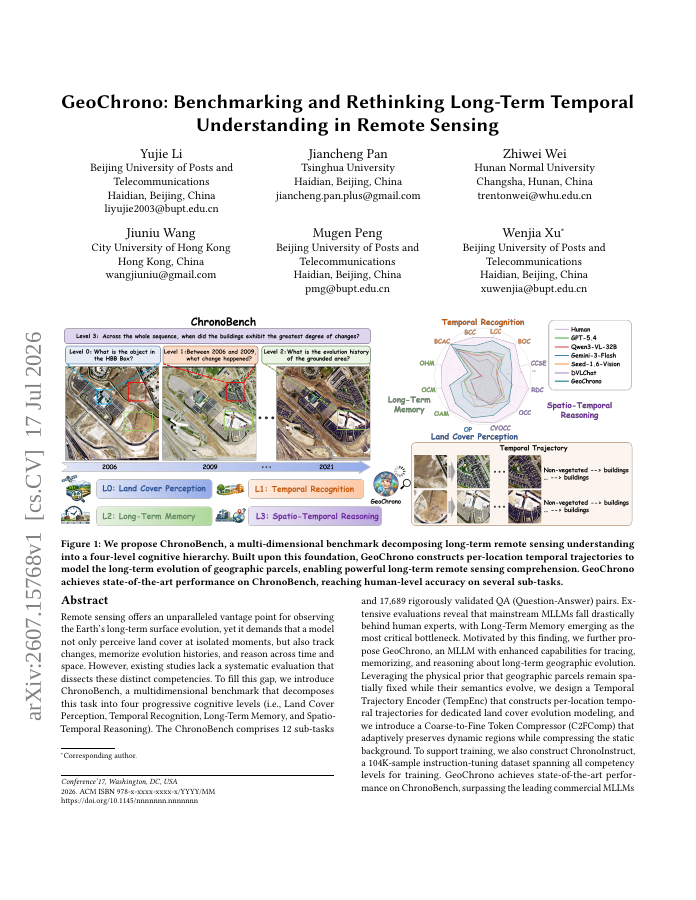
Remote sensing offers an unparalleled vantage point for observing the Earth's long-term surface evolution, yet it demands that a model not only perceive land cover at isolated moments, but also track changes, memorize evolution histories, and reason across time and space. However, existing studies lack a systematic evaluation that dissects these distinct competencies. To fill this gap, we introduce ChronoBench, a multidimensional benchmark that decomposes this task into four progressive cognitive levels (i.e., Land Cover Perception, Temporal Recognition, Long-Term Memory, and Spatio-Temporal Reasoning). The ChronoBench comprises 12 sub-tasks and 17,689 rigorously validated QA (Question-Answer) pairs. Extensive evaluations reveal that mainstream MLLMs fall drastically behind human experts, with Long-Term Memory emerging as the most critical bottleneck. Motivated by this finding, we further propose GeoChrono, an MLLM with enhanced capabilities for tracing, memorizing, and reasoning about long-term geographic evolution. Leveraging the physical prior that geographic parcels remain spatially fixed while their semantics evolve, we design a Temporal Trajectory Encoder (TempEnc) that constructs per-location temporal trajectories for dedicated land cover evolution modeling, and we introduce a Coarse-to-Fine Token Compressor (C2FComp) that adaptively preserves dynamic regions while compressing the static background. To support training, we also construct ChronoInstruct, a 104K-sample instruction-tuning dataset spanning all competency levels for training. GeoChrono achieves state-of-the-art performance on ChronoBench, surpassing the leading commercial MLLMs by over 20%, while C2FComp reduces visual tokens by over 56% while retaining GeoChrono's 94.6% performance. The code and data will be available at https://github.com/IntelliSensing/GeoChrono
GeoChrono: Benchmarking and Rethinking Long-Term Temporal Understanding in Remote Sensing
Remote sensing offers an unparalleled vantage point for observing the Earth's long-term surface evolution, yet it demands that a model not only perceive land cover at isolated moments, but also track changes, memorize evolution histories, and reason across time and space.
- Preview
- Year
- 2026
- Hosting
- Abstract onlyARXIV-DEFAULT
Cite
Notes
Only stored in your browser.
Attribution
- Abstract & full text
- arxiv.org/abs/2607.15768ARXIV-DEFAULT
- TL;DR
- Semantic Scholar