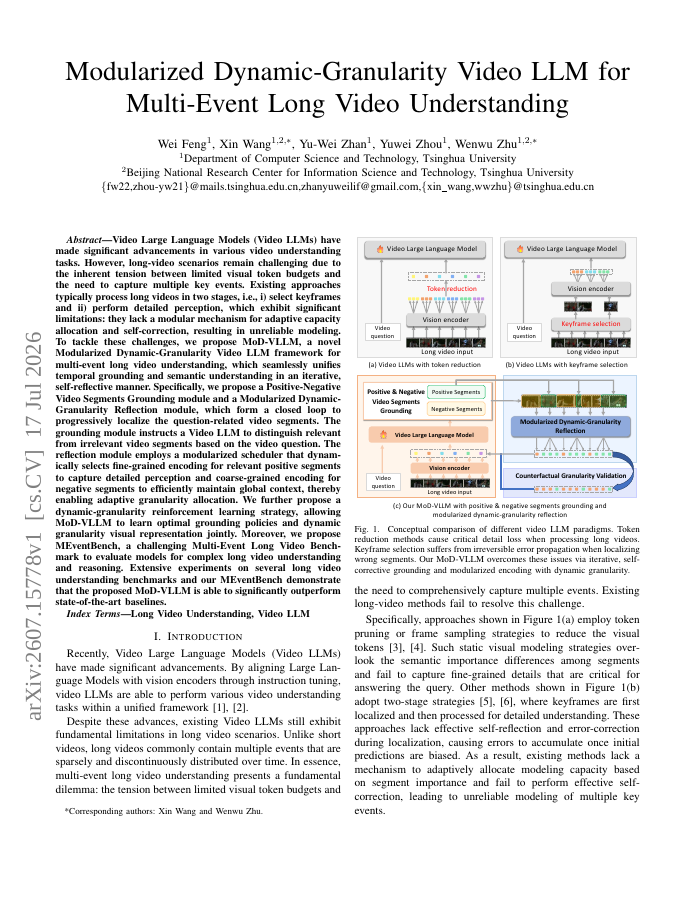
Video Large Language Models (Video LLMs) have made significant advancements in various video understanding tasks. However, long-video scenarios remain challenging due to the tension between limited visual token budgets and the need to capture multiple key events. Existing approaches typically process long videos in two stages, i.e., i) select keyframes and ii) perform detailed perception, which exhibit limitations: they lack a modular mechanism for adaptive capacity allocation and self-correction, resulting in unreliable modeling. To tackle these challenges, we propose MoD-VLLM, a novel Modularized Dynamic-Granularity Video LLM framework for multi-event long video understanding, which unifies temporal grounding and semantic understanding iteratively and self-reflectively. Specifically, we propose a Positive-Negative Video Segments Grounding module and a Modularized Dynamic-Granularity Reflection module, which form a closed loop to progressively localize the question-related video segments. The grounding module instructs a Video LLM to distinguish relevant from irrelevant video segments based on the video question. The reflection module employs a modularized scheduler that dynamically selects fine-grained encoding for relevant positive segments to capture detailed perception and coarse-grained encoding for negative segments to maintain global context. We further propose a dynamic-granularity reinforcement learning strategy, allowing MoD-VLLM to learn optimal grounding policies and dynamic granularity visual representation jointly. Moreover, we propose MEventBench, a challenging Multi-Event Long Video Benchmark for complex long video reasoning. Extensive experiments on several long video understanding benchmarks and our MEventBench demonstrate that MoD-VLLM significantly outperforms state-of-the-art baselines.
Modularized Dynamic-Granularity Video LLM for Multi-Event Long Video Understanding
Video Large Language Models (Video LLMs) have made significant advancements in various video understanding tasks. However, long-video scenarios remain challenging due to the tension between limited visual token budgets and the need to capture multiple key events.
- Preview
- Year
- 2026
- Hosting
- Excerpt onlyCC-BY-NC-4.0
Cite
Notes
Only stored in your browser.
Attribution
- Abstract & full text
- arxiv.org/abs/2607.15778CC-BY-NC-4.0
- TL;DR
- Semantic Scholar