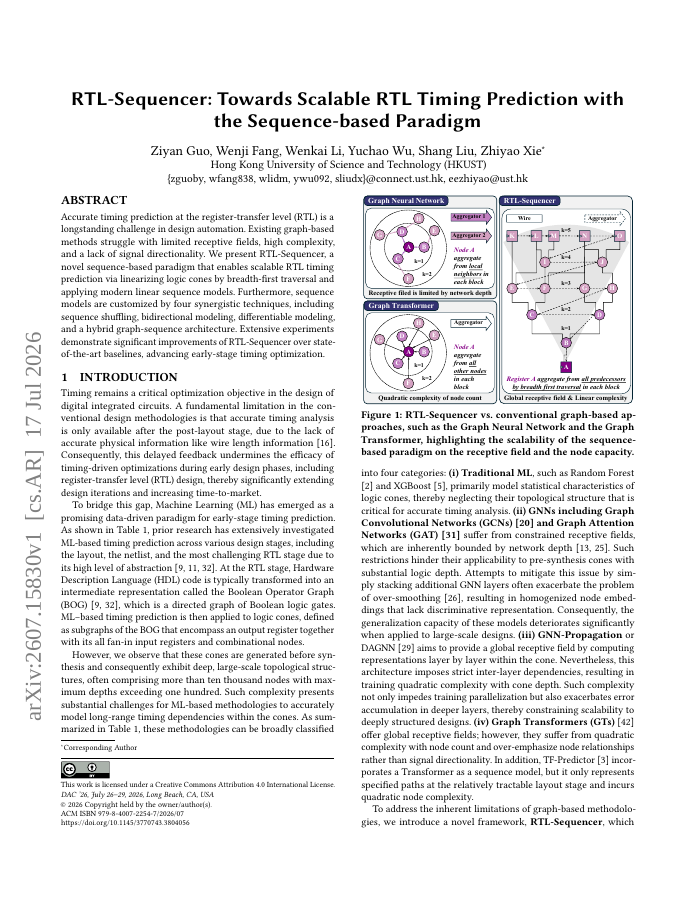
Accurate timing prediction at the register-transfer level (RTL) is a longstanding challenge in design automation. Existing graph-based methods struggle with limited receptive fields, high complexity, and a lack of signal directionality. We present RTL-Sequencer, a novel sequence-based paradigm that enables scalable RTL timing prediction via linearizing logic cones by breadth-first traversal and applying modern linear sequence models. Furthermore, sequence models are customized by four synergistic techniques, including sequence shuffling, bidirectional modeling, differentiable modeling, and a hybrid graph-sequence architecture. Extensive experiments demonstrate significant improvements of RTL-Sequencer over state-of-the-art baselines, advancing early-stage timing optimization.
RTL-Sequencer: Towards Scalable RTL Timing Prediction with the Sequence-based Paradigm
Accurate timing prediction at the register-transfer level (RTL) is a longstanding challenge in design automation. Existing graph-based methods struggle with limited receptive fields, high complexity, and a lack of signal directionality.
- Preview
- Year
- 2026
- Hosting
- Full text hostedCC-BY-4.0
Cite
Notes
Only stored in your browser.
Attribution
- Abstract & full text
- arxiv.org/abs/2607.15830CC-BY-4.0
- TL;DR
- Semantic Scholar