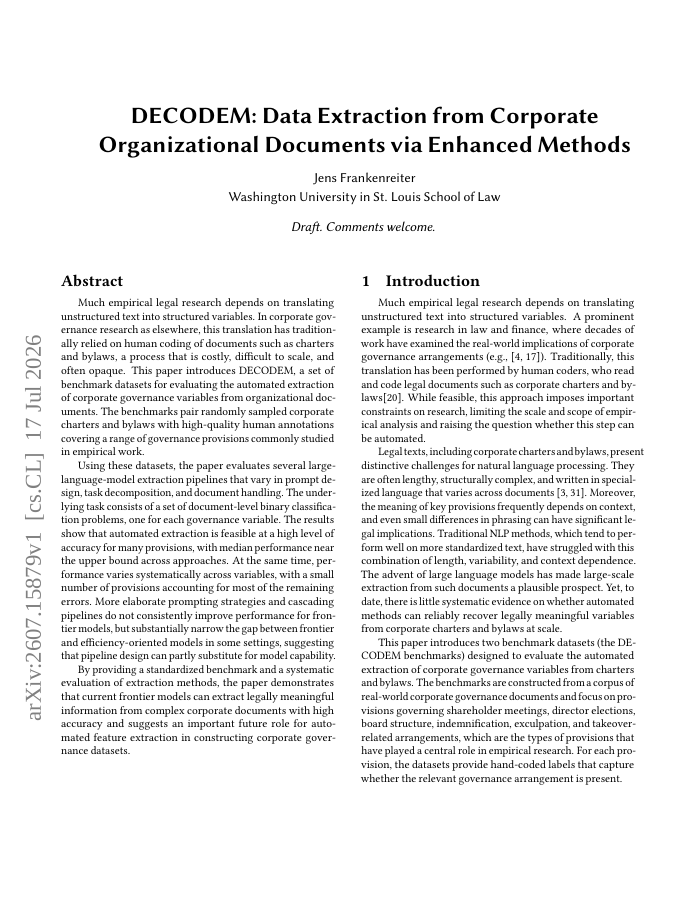
Much empirical legal research depends on translating unstructured text into structured variables. In corporate governance research as elsewhere, this translation has traditionally relied on human coding of documents such as charters and bylaws, a process that is costly, difficult to scale, and often opaque. This paper introduces DECODEM, a set of benchmark datasets for evaluating the automated extraction of corporate governance variables from organizational documents. The benchmarks pair randomly sampled corporate charters and bylaws with high-quality human annotations covering a range of governance provisions commonly studied in empirical work. Using these datasets, the paper evaluates several large-language-model extraction pipelines that vary in prompt design, task decomposition, and document handling. The underlying task consists of a set of document-level binary classification problems, one for each governance variable. The results show that automated extraction is feasible at a high level of accuracy for many provisions, with median performance near the upper bound across approaches. At the same time, performance varies systematically across variables, with a small number of provisions accounting for most of the remaining errors. More elaborate prompting strategies and cascading pipelines do not consistently improve performance for frontier models, but substantially narrow the gap between frontier and efficiency-oriented models in some settings, suggesting that pipeline design can partly substitute for model capability. By providing a standardized benchmark and a systematic evaluation of extraction methods, the paper demonstrates that current frontier models can extract legally meaningful information from complex corporate documents with high accuracy and suggests an important future role for automated feature extraction in constructing corporate governance datasets.
DECODEM: Data Extraction from Corporate Organizational Documents via Enhanced Methods
Much empirical legal research depends on translating unstructured text into structured variables. In corporate governance research as elsewhere, this translation has traditionally relied on human coding of documents such as charters and bylaws, a process that is costly,…
- Preview
- Year
- 2026
- Hosting
- Excerpt onlyCC-BY-NC-4.0
Cite
Notes
Only stored in your browser.
Attribution
- Abstract & full text
- arxiv.org/abs/2607.15879CC-BY-NC-4.0
- TL;DR
- Semantic Scholar