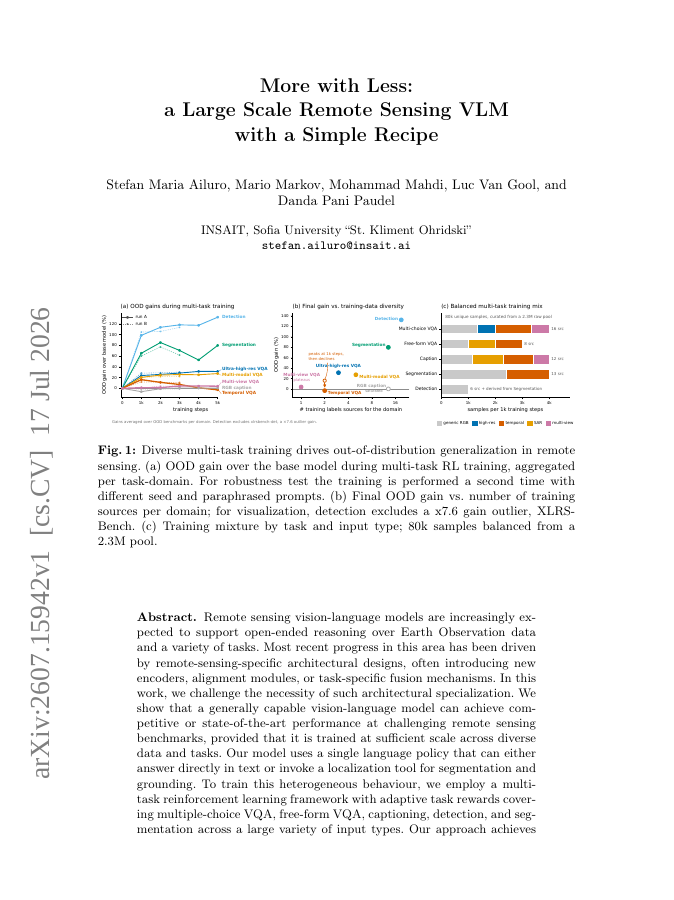
Remote sensing vision-language models are increasingly expected to support open-ended reasoning over Earth Observation data and a variety of tasks. Most recent progress in this area has been driven by remote-sensing-specific architectural designs, often introducing new encoders, alignment modules, or task-specific fusion mechanisms. In this work, we challenge the necessity of such architectural specialization. We show that a generally capable vision-language model can achieve competitive or state-of-the-art performance at challenging remote sensing benchmarks, provided that it is trained at sufficient scale across diverse data and tasks. Our model uses a single language policy that can either answer directly in text or invoke a localization tool for segmentation and grounding. To train this heterogeneous behaviour, we employ a multi-task reinforcement learning framework with adaptive task rewards covering multiple-choice VQA, free-form VQA, captioning, detection, and segmentation across a large variety of input types. Our approach achieves competitive results across a broad set of benchmarks, including high-resolution, multi-temporal, multi-modal and multi-view tasks. Further, as training data scales, our experiments show consistent improvements across most tasks both in and out of distribution, which correlate with per-task data diversity. These findings suggest that, for remote sensing VLMs, data scale is more important than architectural novelty.
More with Less: a Large Scale Remote Sensing VLM with a Simple Recipe
Remote sensing vision-language models are increasingly expected to support open-ended reasoning over Earth Observation data and a variety of tasks. Most recent progress in this area has been driven by remote-sensing-specific architectural designs, often introducing new encoders,…
- Preview
- Year
- 2026
- Hosting
- Abstract onlyARXIV-DEFAULT
Cite
Notes
Only stored in your browser.
Attribution
- Abstract & full text
- arxiv.org/abs/2607.15942ARXIV-DEFAULT
- TL;DR
- Semantic Scholar