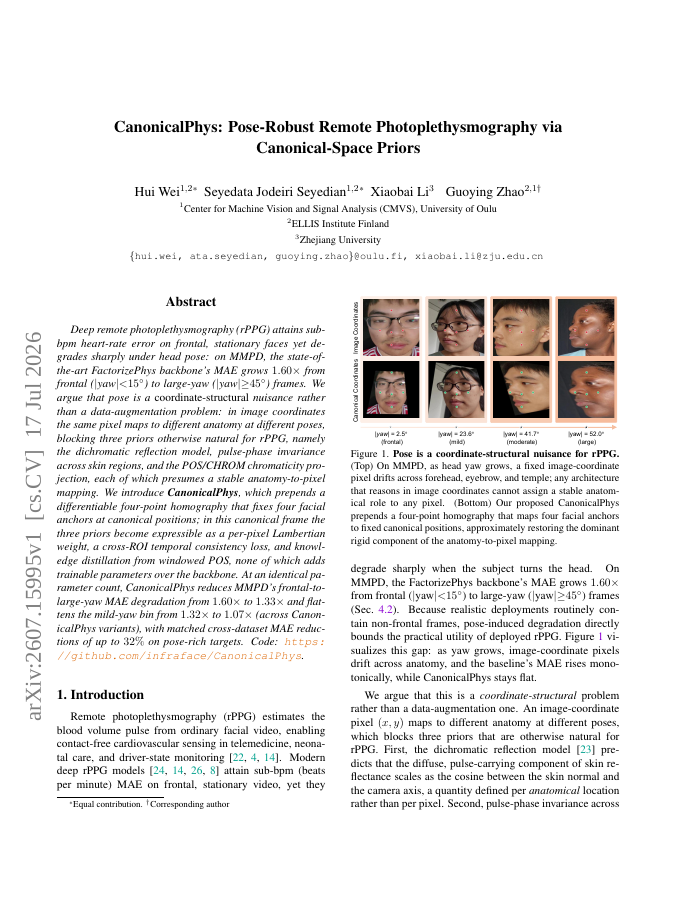
Deep remote photoplethysmography (rPPG) attains sub-bpm heart-rate error on frontal, stationary faces yet degrades sharply under head pose: on MMPD, the state-of-the-art FactorizePhys backbone's MAE grows 1.60\times from frontal (|yaw|{<}15^\circ) to large-yaw (|yaw|{\geq}45^\circ) frames. We argue that pose is a coordinate-structural nuisance rather than a data-augmentation problem: in image coordinates the same pixel maps to different anatomy at different poses, blocking three priors otherwise natural for rPPG, namely the dichromatic reflection model, pulse-phase invariance across skin regions, and the POS/CHROM chromaticity projection, each of which presumes a stable anatomy-to-pixel mapping. We introduce CanonicalPhys, which prepends a differentiable four-point homography that fixes four facial anchors at canonical positions; in this canonical frame the three priors become expressible as a per-pixel Lambertian weight, a cross-ROI temporal consistency loss, and knowledge distillation from windowed POS, none of which adds trainable parameters over the backbone. At an identical parameter count, CanonicalPhys reduces MMPD's frontal-to-large-yaw MAE degradation from 1.60\times to 1.33\times and flattens the mild-yaw bin from 1.32\times to 1.07\times (across CanonicalPhys variants), with matched cross-dataset MAE reductions of up to 32% on pose-rich targets. Code: https://github.com/infraface/CanonicalPhys
CanonicalPhys: Pose-Robust Remote Photoplethysmography via Canonical-Space Priors
Deep remote photoplethysmography (rPPG) attains sub-bpm heart-rate error on frontal, stationary faces yet degrades sharply under head pose: on MMPD, the state-of-the-art FactorizePhys backbone's MAE grows $1.60\times$ from frontal ($|\text{yaw}|{<}15^\circ$) to large-yaw…
- Preview
- Year
- 2026
- Hosting
- Full text hostedCC-BY-4.0
Cite
Notes
Only stored in your browser.
Attribution
- Abstract & full text
- arxiv.org/abs/2607.15995CC-BY-4.0
- TL;DR
- Semantic Scholar