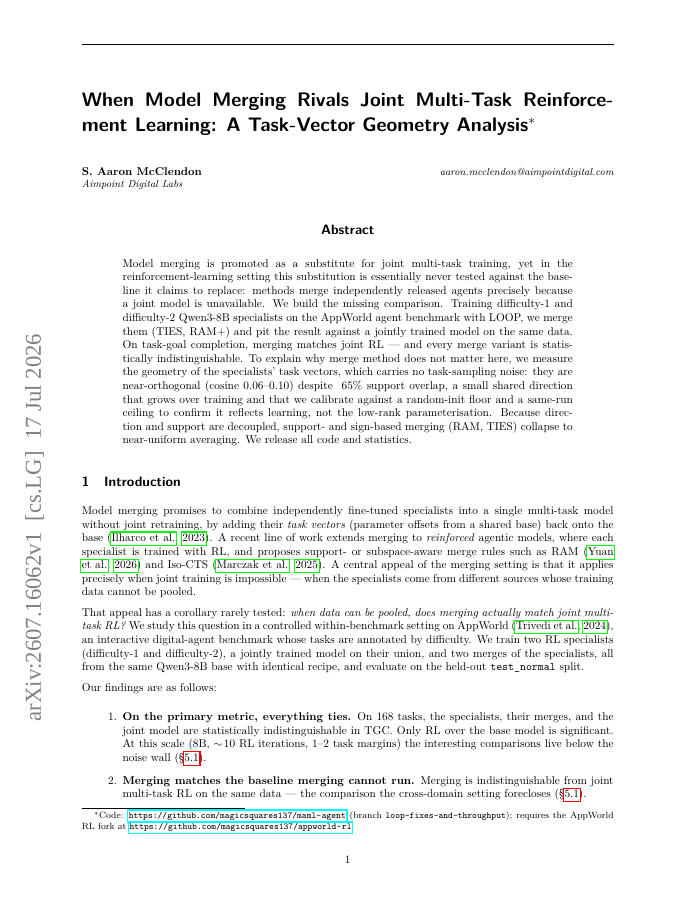
Model merging is promoted as a substitute for joint multi-task training, yet in the reinforcement-learning setting this substitution is essentially never tested against the baseline it claims to replace: methods merge independently released agents precisely because a joint model is unavailable. We build the missing comparison. Training difficulty-1 and difficulty-2 Qwen3-8B specialists on the AppWorld agent benchmark with LOOP, we merge them (TIES, RAM+) and pit the result against a jointly trained model on the same data. On task-goal completion, merging matches joint RL -- and every merge variant is statistically indistinguishable. To explain why merge method does not matter here, we measure the geometry of the specialists' task vectors, which carries no task-sampling noise: they are near-orthogonal (cosine 0.06 - 0.10) despite 65% support overlap, a small, shared direction that grows over training and that we calibrate against a random-init floor and a same-run ceiling to confirm it reflects learning, not the low-rank parameterization. Because direction and support are decoupled, support and sign-based merging (RAM, TIES) collapse to near-uniform averaging. We release all code and statistics.
When Model Merging Rivals Joint Multi-Task Reinforcement Learning: A Task-Vector Geometry Analysis
Model merging is promoted as a substitute for joint multi-task training, yet in the reinforcement-learning setting this substitution is essentially never tested against the baseline it claims to replace: methods merge independently released agents precisely because a joint model…
- Preview
- Year
- 2026
- Hosting
- Full text hostedCC-BY-4.0
Cite
Notes
Only stored in your browser.
Attribution
- Abstract & full text
- arxiv.org/abs/2607.16062CC-BY-4.0
- TL;DR
- Semantic Scholar