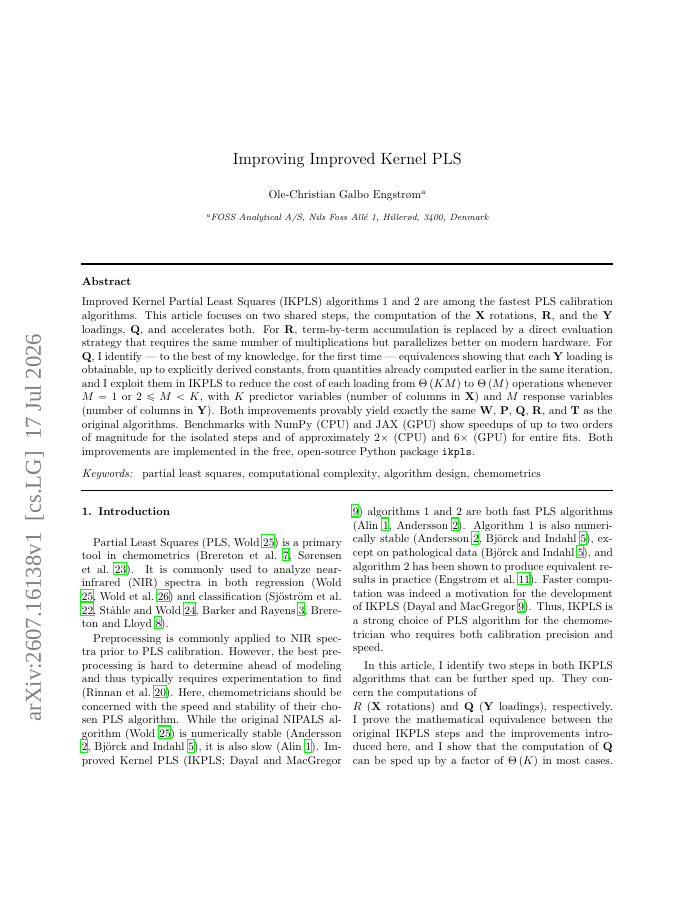
Improved Kernel Partial Least Squares (IKPLS) algorithms 1 and 2 are among the fastest PLS calibration algorithms. This article focuses on two shared steps, the computation of the X rotations, R, and the Y loadings, Q, and accelerates both. For R, term-by-term accumulation is replaced by a direct evaluation strategy that requires the same number of multiplications but parallelizes better on modern hardware. For Q, I identify - to the best of my knowledge, for the first time - equivalences showing that each Y loading is obtainable, up to explicitly derived constants, from quantities already computed earlier in the same iteration, and I exploit them in IKPLS to reduce the cost of each loading from Θ\left(KM\right) to Θ\left(M\right) operations whenever M = 1 or 2 \leq M < K, with K predictor variables (number of columns in X) and M response variables (number of columns in Y). Both improvements provably yield exactly the same W, P, Q, R, and T as the original algorithms. Benchmarks with NumPy (CPU) and JAX (GPU) show speedups of up to two orders of magnitude for the isolated steps and of approximately 2\times (CPU) and 6\times (GPU) for entire fits. Both improvements are implemented in the free, open-source Python package ikpls.
Improving Improved Kernel PLS
Improved Kernel Partial Least Squares (IKPLS) algorithms 1 and 2 are among the fastest PLS calibration algorithms. This article focuses on two shared steps, the computation of the $\mathbf{X}$ rotations, $\mathbf{R}$, and the $\mathbf{Y}$ loadings, $\mathbf{Q}$, and accelerates…
- Preview
- Year
- 2026
- Hosting
- Full text hostedCC-BY-4.0
Cite
Notes
Only stored in your browser.
Attribution
- Abstract & full text
- arxiv.org/abs/2607.16138CC-BY-4.0
- TL;DR
- Semantic Scholar