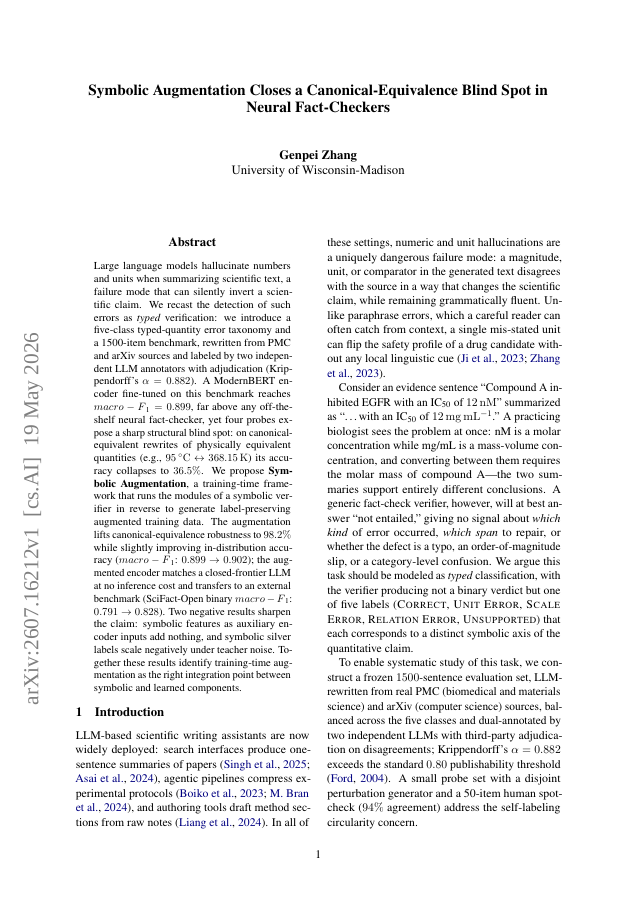
Large language models hallucinate numbers and units when summarizing scientific text, a failure mode that can silently invert a scientific claim. We recast the detection of such errors as typed verification: we introduce a five-class typed-quantity error taxonomy and a 1500-item benchmark, rewritten from PMC and arXiv sources and labeled by two independent LLM annotators with adjudication (Krippendorff's alpha = 0.882). A ModernBERT encoder fine-tuned on this benchmark reaches macro-F1 = 0.899, far above any off-the-shelf neural fact-checker, yet four probes expose a sharp structural blind spot: on canonical-equivalent rewrites of physically equivalent quantities (e.g., 95°C and 368.15 K) its accuracy collapses to 36.5%. We propose Symbolic Augmentation, a training-time framework that runs the modules of a symbolic verifier in reverse to generate label-preserving augmented training data. The augmentation lifts canonical-equivalence robustness to 98.2% while slightly improving in-distribution accuracy (macro-F1: 0.899 to 0.902); the augmented encoder matches a closed-frontier LLM at no inference cost and transfers to an external benchmark (SciFact-Open binary macro-F1: 0.791 to 0.828). Two negative results sharpen the claim: symbolic features as auxiliary encoder inputs add nothing, and symbolic silver labels scale negatively under teacher noise. Together these results identify training-time augmentation as the right integration point between symbolic and learned components.
Symbolic Augmentation Closes a Canonical-Equivalence Blind Spot in Neural Fact-Checkers
Large language models hallucinate numbers and units when summarizing scientific text, a failure mode that can silently invert a scientific claim. We recast the detection of such errors as typed verification: we introduce a five-class typed-quantity error taxonomy and a 1500-item…
- Preview
- Year
- 2026
- Hosting
- Full text hostedCC-BY-4.0
Cite
Notes
Only stored in your browser.
Attribution
- Abstract & full text
- arxiv.org/abs/2607.16212CC-BY-4.0
- TL;DR
- Semantic Scholar