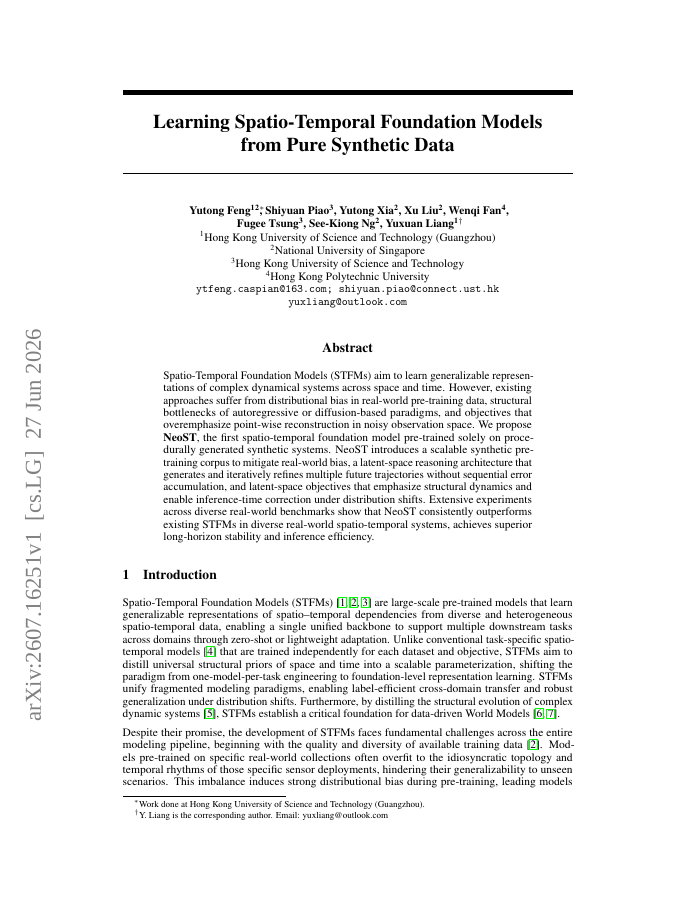
Spatio-Temporal Foundation Models (STFMs) aim to learn generalizable representations of complex dynamical systems across space and time. However, existing approaches suffer from distributional bias in real-world pre-training data, structural bottlenecks of autoregressive or diffusion-based paradigms, and objectives that overemphasize point-wise reconstruction in noisy observation space.We propose NeoST, the first spatio-temporal foundation model pre-trained solely on procedurally generated synthetic systems. NeoST introduces a scalable synthetic pre-training corpus to mitigate real-world bias, a latent-space reasoning architecture that generates and iteratively refines multiple future trajectories without sequential error accumulation, and latent-space objectives that emphasize structural dynamics and enable inference-time correction under distribution shifts.Extensive experiments across diverse real-world benchmarks show that NeoST consistently outperforms existing STFMs in diverse real-world spatio-temporal systems, achieves superior long-horizon stability and inference efficiency.
Learning Spatio-Temporal Foundation Models from Pure Synthetic Data
Spatio-Temporal Foundation Models (STFMs) aim to learn generalizable representations of complex dynamical systems across space and time. However, existing approaches suffer from distributional bias in real-world pre-training data, structural bottlenecks of autoregressive or…
- Preview
- Year
- 2026
- Hosting
- Excerpt onlyCC-BY-NC-SA-4.0
Cite
Notes
Only stored in your browser.
Attribution
- Abstract & full text
- arxiv.org/abs/2607.16251CC-BY-NC-SA-4.0
- TL;DR
- Semantic Scholar