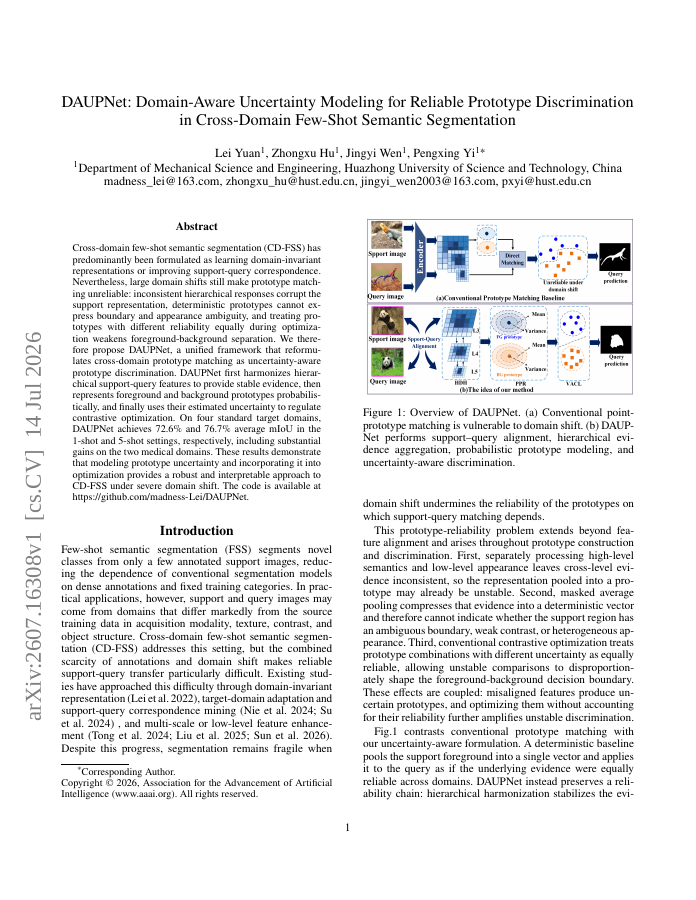
Cross-domain few-shot semantic segmentation (CD-FSS) has predominantly been formulated as learning domain-invariant representations or improving support-query correspondence. Nevertheless, large domain shifts still make prototype matching unreliable: inconsistent hierarchical responses corrupt the support representation, deterministic prototypes cannot express boundary and appearance ambiguity, and treating prototypes with different reliability equally during optimization weakens foreground-background separation. We therefore propose DAUPNet, a unified framework that reformulates cross-domain prototype matching as uncertainty-aware prototype discrimination. DAUPNet first harmonizes hierarchical support-query features to provide stable evidence, then represents foreground and background prototypes probabilistically, and finally uses their estimated uncertainty to regulate contrastive optimization. On four standard target domains, DAUPNet achieves 72.6% and 76.7% average mIoU in the 1-shot and 5-shot settings, respectively, including substantial gains on the two medical domains. These results demonstrate that modeling prototype uncertainty and incorporating it into optimization provides a robust and interpretable approach to CD-FSS under severe domain shift. The code is available at https://github.com/madness-Lei/DAUPNet
DAUPNet: Domain-Aware Uncertainty Modeling for Reliable Prototype Discrimination in Cross-Domain Few-Shot Semantic Segmentation
Cross-domain few-shot semantic segmentation (CD-FSS) has predominantly been formulated as learning domain-invariant representations or improving support-query correspondence.
- Preview
- Year
- 2026
- Hosting
- Abstract onlyARXIV-DEFAULT
Cite
Notes
Only stored in your browser.
Attribution
- Abstract & full text
- arxiv.org/abs/2607.16308ARXIV-DEFAULT
- TL;DR
- Semantic Scholar