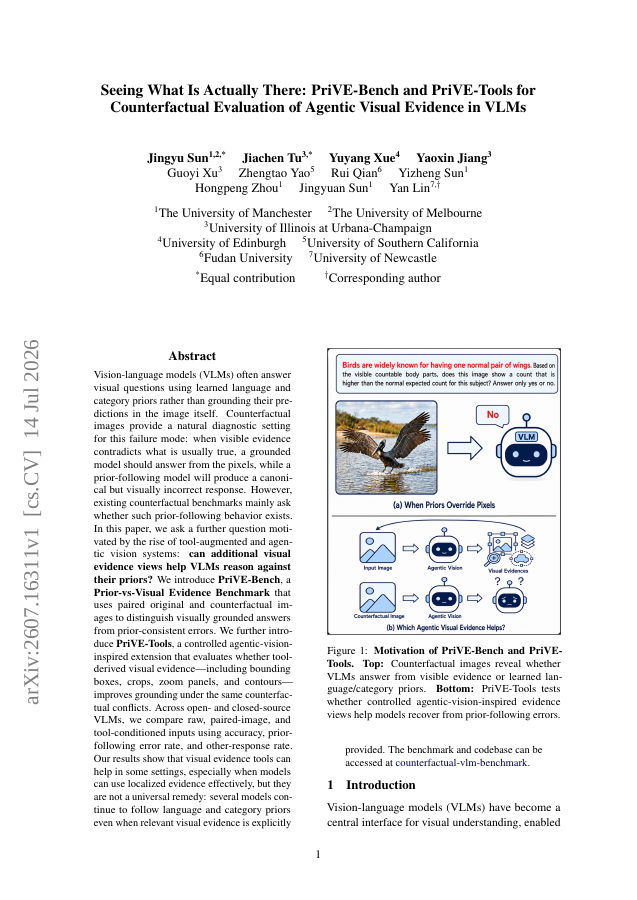
Vision-language models (VLMs) often answer visual questions using learned language and category priors rather than grounding their predictions in the image itself. Counterfactual images provide a natural diagnostic setting for this failure mode: when visible evidence contradicts what is usually true, a grounded model should answer from the pixels, while a prior-following model will produce a canonical but visually incorrect response. However, existing counterfactual benchmarks mainly ask whether such prior-following behavior exists. In this paper, we ask a further question motivated by the rise of tool-augmented and agentic vision systems: can additional visual evidence views help VLMs reason against their priors? We introduce PriVE-Bench, a Prior-vs-Visual Evidence Benchmark that uses paired original and counterfactual images to distinguish visually grounded answers from prior-consistent errors. We further introduce PriVE-Tools, a controlled agentic-vision-inspired extension that evaluates whether tool-derived visual evidence -- including bounding boxes, crops, zoom panels, and contours -- improves grounding under the same counterfactual conflicts. Across open- and closed-source VLMs, we compare raw, paired-image, and tool-conditioned inputs using accuracy, prior-following error rate, and other-response rate. Our results show that visual evidence tools can help in some settings, especially when models can use localized evidence effectively, but they are not a universal remedy: several models continue to follow language and category priors even when relevant visual evidence is explicitly provided.
Seeing What Is Actually There: PriVE-Bench and PriVE-Tools for Counterfactual Evaluation of Agentic Visual Evidence in VLMs
Vision-language models (VLMs) often answer visual questions using learned language and category priors rather than grounding their predictions in the image itself. Counterfactual images provide a natural diagnostic setting for this failure mode: when visible evidence contradicts…
- Preview
- Year
- 2026
- Hosting
- Abstract onlyARXIV-DEFAULT
Cite
Notes
Only stored in your browser.
Attribution
- Abstract & full text
- arxiv.org/abs/2607.16311ARXIV-DEFAULT
- TL;DR
- Semantic Scholar