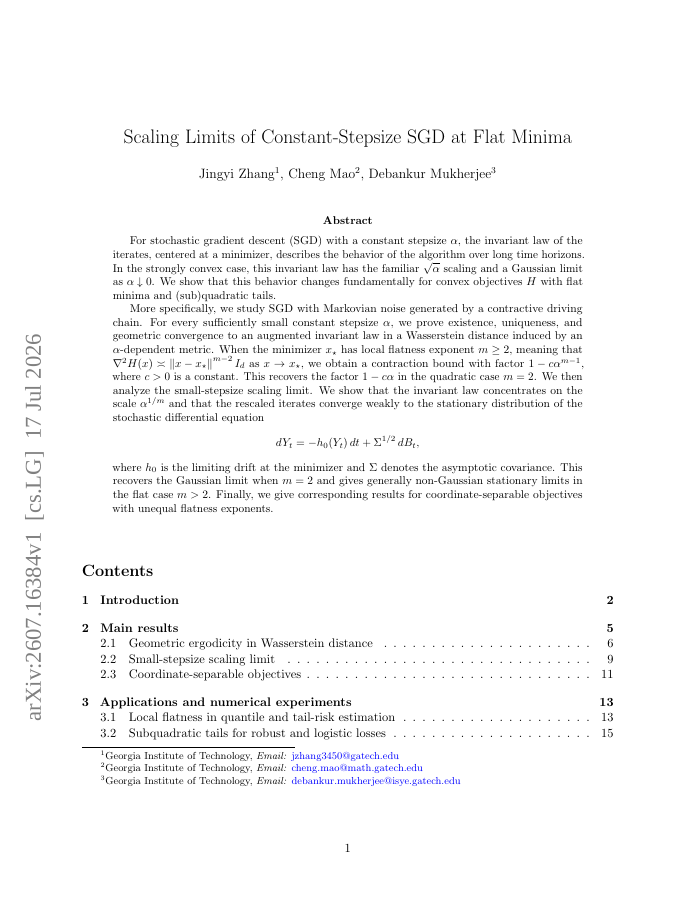
For stochastic gradient descent (SGD) with a constant stepsize α, the invariant law of the iterates, centered at a minimizer, describes the behavior of the algorithm over long time horizons. In the strongly convex case, this invariant law has the familiar \sqrtα scaling and a Gaussian limit as α\downarrow 0. We show that this behavior changes fundamentally for convex objectives H with flat minima and (sub)quadratic tails. More specifically, we study SGD with Markovian noise generated by a contractive driving chain. For every sufficiently small constant stepsize α, we prove existence, uniqueness, and geometric convergence to an augmented invariant law in a Wasserstein distance induced by an α-dependent metric. When the minimizer x_\star has local flatness exponent m\ge2, meaning that \nabla^2 H(x)\asymp \lVert x-x_\star\rVert^{m-2} I_d as x\to x_\star, we obtain a contraction bound with factor 1-cα^{m-1}, where c>0 is a constant. This recovers the factor 1-cα in the quadratic case m=2. We then analyze the small-stepsize scaling limit. We show that the invariant law concentrates on the scale α^{1/m} and that the rescaled iterates converge weakly to the stationary distribution of the stochastic differential equation $ dY_t=-h_0(Y_t),dt+Σ^{1/2},dB_t , where h_0 is the limiting drift at the minimizer and Σ denotes the asymptotic covariance. This recovers the Gaussian limit when m=2 and gives generally non-Gaussian stationary limits in the flat case m>2$. Finally, we give corresponding results for coordinate-separable objectives with unequal flatness exponents.
Scaling Limits of Constant-Stepsize SGD at Flat Minima
For stochastic gradient descent (SGD) with a constant stepsize $α$, the invariant law of the iterates, centered at a minimizer, describes the behavior of the algorithm over long time horizons.
- Preview
- Year
- 2026
- Hosting
- Abstract onlyARXIV-DEFAULT
Cite
Notes
Only stored in your browser.
Attribution
- Abstract & full text
- arxiv.org/abs/2607.16384ARXIV-DEFAULT
- TL;DR
- Semantic Scholar