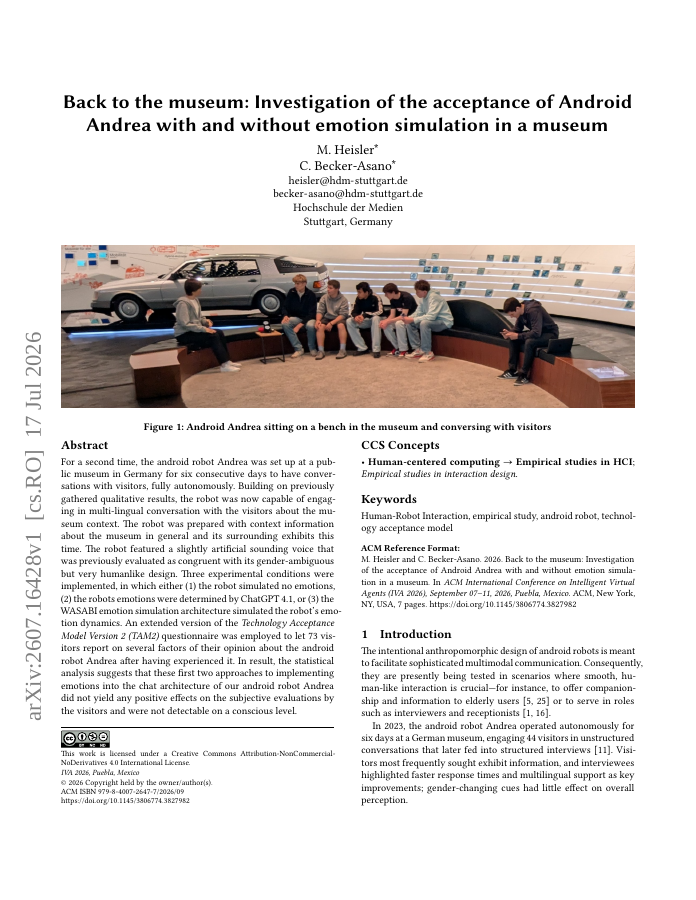
For a second time, the android robot Andrea was set up at a public museum in Germany for six consecutive days to have conversations with visitors, fully autonomously. Building on previously gathered qualitative results, the robot was now capable of engaging in multi-lingual conversation with the visitors about the museum context. The robot was prepared with context information about the museum in general and its surrounding exhibits this time. The robot featured a slightly artificial sounding voice that was previously evaluated as congruent with its gender-ambiguous but very humanlike design. Three experimental conditions were implemented, in which either (1) the robot simulated no emotions, (2) the robots emotions were determined by ChatGPT 4.1, or (3) the WASABI emotion simulation architecture simulated the robot's emotion dynamics. An extended version of the TAM2 questionnaire was employed to let 73 visitors report on several factors of their opinion about the android robot Andrea after having experienced it. In result, the statistical analysis suggests that these first two approaches to implementing emotions into the chat architecture of our android robot Andrea did not yield any positive effects on the subjective evaluations by the visitors and were not detectable on a conscious level.
Back to the museum: Investigation of the acceptance of Android Andrea with and without emotion simulation in a museum
For a second time, the android robot Andrea was set up at a public museum in Germany for six consecutive days to have conversations with visitors, fully autonomously. Building on previously gathered qualitative results, the robot was now capable of engaging in multi-lingual…
- Preview
- Year
- 2026
- Hosting
- Excerpt onlyCC-BY-NC-SA-4.0
Cite
Notes
Only stored in your browser.
Attribution
- Abstract & full text
- arxiv.org/abs/2607.16428CC-BY-NC-SA-4.0
- TL;DR
- Semantic Scholar