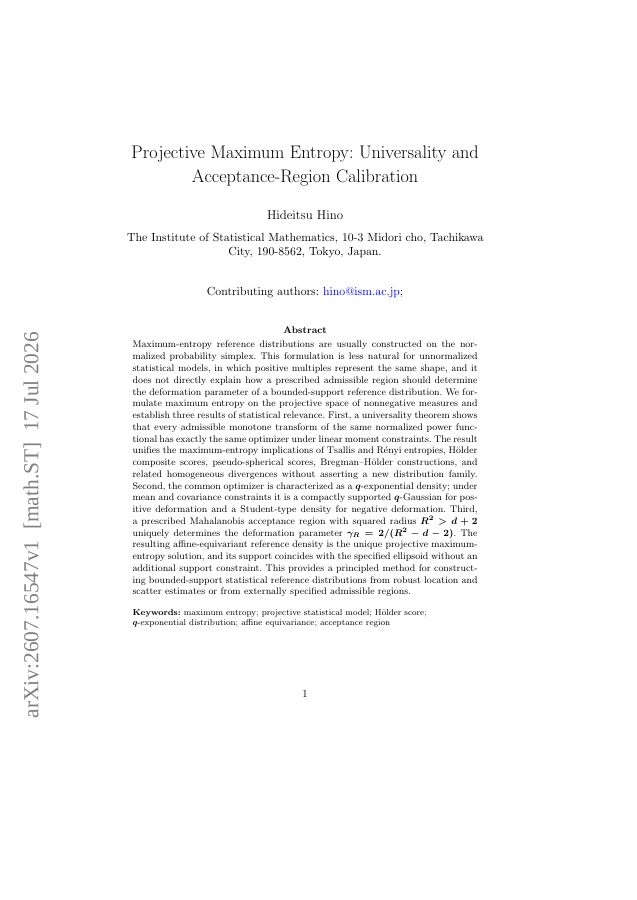
Maximum-entropy reference distributions are usually constructed on the normalized probability simplex. This formulation is less natural for unnormalized statistical models, in which positive multiples represent the same shape, and it does not directly explain how a prescribed admissible region should determine the deformation parameter of a bounded-support reference distribution. We formulate maximum entropy on the projective space of nonnegative measures and establish three results of statistical relevance. First, a universality theorem shows that every admissible monotone transform of the same normalized power functional has exactly the same optimizer under linear moment constraints. The result unifies the maximum-entropy implications of Tsallis and Rényi entropies, Hölder composite scores, pseudo-spherical scores, Bregman--Hölder constructions, and related homogeneous divergences without asserting a new distribution family. Second, the common optimizer is characterized as a q-exponential density; under mean and covariance constraints it is a compactly supported q-Gaussian for positive deformation and a Student-type density for negative deformation. Third, a prescribed Mahalanobis acceptance region with squared radius R^2>d+2 uniquely determines the deformation parameter γ_R=2/(R^2-d-2). The resulting affine-equivariant reference density is the unique projective maximum-entropy solution, and its support coincides with the specified ellipsoid without an additional support constraint. This provides a principled method for constructing bounded-support statistical reference distributions from robust location and scatter estimates or from externally specified admissible regions.
Projective Maximum Entropy: Universality and Acceptance-Region Calibration
Maximum-entropy reference distributions are usually constructed on the normalized probability simplex. This formulation is less natural for unnormalized statistical models, in which positive multiples represent the same shape, and it does not directly explain how a prescribed…
- Preview
- Year
- 2026
- Hosting
- Full text hostedCC-BY-4.0
Cite
Notes
Only stored in your browser.
Attribution
- Abstract & full text
- arxiv.org/abs/2607.16547CC-BY-4.0
- TL;DR
- Semantic Scholar