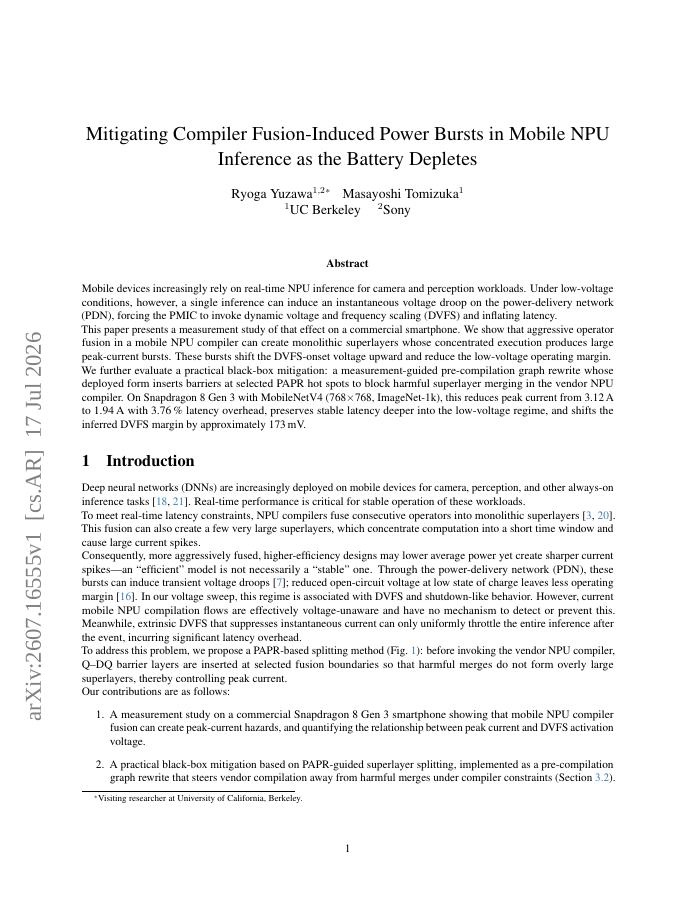
Mobile devices increasingly rely on real-time NPU inference for camera and perception workloads. Under low-voltage conditions, however, a single inference can induce an instantaneous voltage droop in the power-delivery network, causing the power management integrated circuit to invoke dynamic voltage and frequency scaling (DVFS) and increase latency. We present a measurement study of this effect on a commercial smartphone. We show that aggressive operator fusion in a mobile NPU compiler can create monolithic superlayers whose concentrated execution produces large peak-current bursts. These bursts shift the DVFS-onset voltage upward and reduce the low-voltage operating margin. We further evaluate a practical black-box mitigation: a measurement-guided, pre-compilation graph rewrite that inserts barriers at selected peak-to-average power ratio hot spots to prevent harmful superlayer merging in the vendor NPU compiler. On Snapdragon 8 Gen 3 with MobileNetV4 at 768 x 768 resolution on ImageNet-1k, this method reduces peak current from 3.12 A to 1.94 A with 3.76% latency overhead, preserves stable latency deeper into the low-voltage regime, and shifts the inferred DVFS margin by approximately 173 mV.
Mitigating Compiler Fusion-Induced Power Bursts in Mobile NPU Inference as the Battery Depletes
Mobile devices increasingly rely on real-time NPU inference for camera and perception workloads. Under low-voltage conditions, however, a single inference can induce an instantaneous voltage droop in the power-delivery network, causing the power management integrated circuit to…
- Preview
- Year
- 2026
- Hosting
- Abstract onlyARXIV-DEFAULT
Cite
Notes
Only stored in your browser.
Attribution
- Abstract & full text
- arxiv.org/abs/2607.16555ARXIV-DEFAULT
- TL;DR
- Semantic Scholar