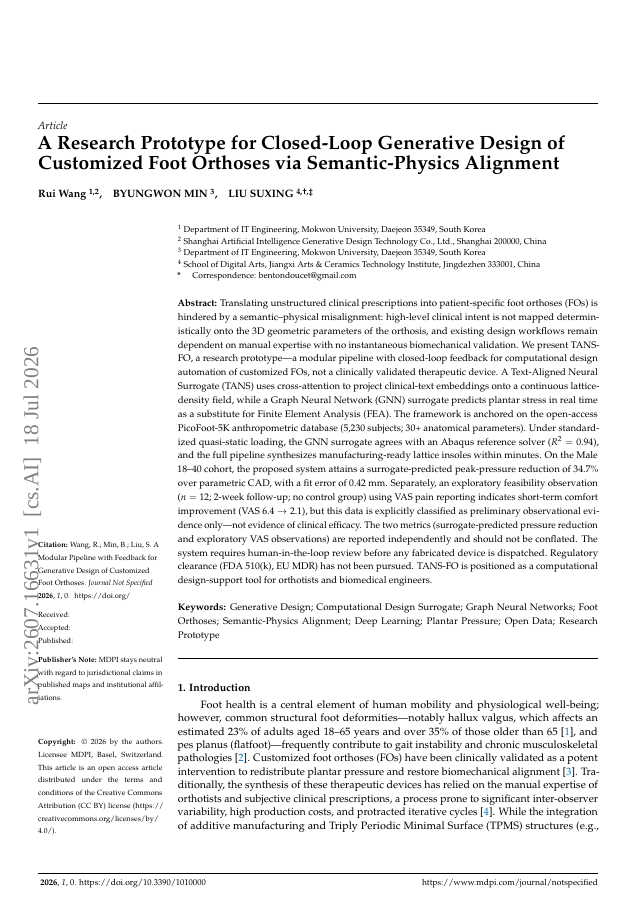
Translating unstructured clinical prescriptions into patient-specific foot orthoses (FOs) is hindered by a semantic-physical misalignment: high-level clinical intent is not mapped deterministically onto the 3D geometric parameters of the orthosis, and existing design workflows remain dependent on manual expertise with no instantaneous biomechanical validation. We present TANS-FO, a research prototype-a modular pipeline with closed-loop feedback for computational design automation of customized FOs, not a clinically validated therapeutic device. A Text-Aligned Neural Surrogate (TANS) uses cross-attention to project clinical-text embeddings onto a continuous lattice-density field, while a Graph Neural Network (GNN) surrogate predicts plantar stress in real time as a substitute for Finite Element Analysis (FEA). The framework is anchored on the open-access PicoFoot-5K anthropometric database (5,230 subjects; 30+ anatomical parameters). Under standardized quasi-static loading, the GNN surrogate agrees with an Abaqus reference solver (R^2 = 0.94), and the full pipeline synthesizes manufacturing-ready lattice insoles within minutes. On the Male 18-40 cohort, the proposed system attains a surrogate-predicted peak-pressure reduction of 34.7% over parametric CAD, with a fit error of 0.42 mm. Separately, an exploratory feasibility observation (n = 12; 2-week follow-up; no control group) using VAS pain reporting indicates short-term comfort improvement (VAS 6.4 -> 2.1), but this data is explicitly classified as preliminary observational evidence only-not evidence of clinical efficacy.
A Research Prototype for Closed-Loop Generative Design of Customized Foot Orthoses via Semantic-Physics Alignment
Translating unstructured clinical prescriptions into patient-specific foot orthoses (FOs) is hindered by a semantic-physical misalignment: high-level clinical intent is not mapped deterministically onto the 3D geometric parameters of the orthosis, and existing design workflows…
- Preview
- Year
- 2026
- Hosting
- Abstract onlyARXIV-DEFAULT
Cite
Notes
Only stored in your browser.
Attribution
- Abstract & full text
- arxiv.org/abs/2607.16631ARXIV-DEFAULT
- TL;DR
- Semantic Scholar