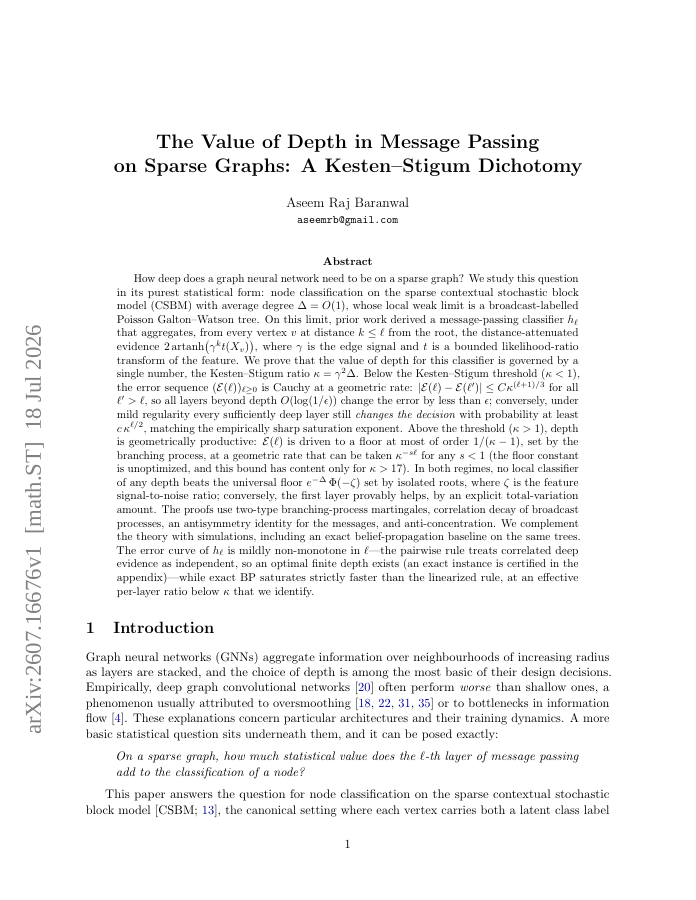
How deep does a graph neural network need to be on a sparse graph? We study its purest statistical form: node classification on the sparse contextual stochastic block model (CSBM) with average degree Δ=O(1), whose local weak limit is a broadcast-labelled Poisson Galton-Watson tree. Prior work derived a message-passing classifier h_\ell that aggregates from each vertex at distance k\le\ell the attenuated evidence 2\operatorname{artanh}(γ^k t(X_v)), with γ the edge signal and t a bounded likelihood-ratio transform of the feature. We prove that the value of depth is governed by a single number, the Kesten-Stigum ratio κ=γ^2Δ. Below the threshold (κ<1), the error sequence is Cauchy at a geometric rate, |E(\ell)-E(\ell')|\le Cκ^{(\ell+1)/3} for all \ell'>\ell, so all layers beyond depth O(\log(1/ε)) change the error by less than ε; conversely, under mild regularity each sufficiently deep layer still flips the decision with probability at least cκ^{\ell/2}, the empirically sharp exponent. Above the threshold (κ>1), depth is geometrically productive: E(\ell) is driven to a branching-process floor of order at most 1/(κ-1) at any geometric rate κ^{-s\ell}, s<1 (this bound has content only for κ>17). No local classifier of any depth beats the universal floor e^{-Δ}Φ(-ζ) set by isolated roots (ζ the feature signal-to-noise ratio), while the first layer provably helps by an explicit total-variation amount. Simulations with an exact belief-propagation baseline on the same trees show that the pairwise rule's error curve is mildly non-monotone in \ell, so an optimal finite depth exists (an exact instance is certified in the appendix), while BP saturates strictly faster, at an effective per-layer ratio below κ that we identify.
The Value of Depth in Message Passing on Sparse Graphs: A Kesten-Stigum Dichotomy
How deep does a graph neural network need to be on a sparse graph? We study its purest statistical form: node classification on the sparse contextual stochastic block model (CSBM) with average degree $Δ=O(1)$, whose local weak limit is a broadcast-labelled Poisson Galton-Watson…
- Preview
- Year
- 2026
- Hosting
- Full text hostedCC-BY-4.0
Cite
Notes
Only stored in your browser.
Attribution
- Abstract & full text
- arxiv.org/abs/2607.16676CC-BY-4.0
- TL;DR
- Semantic Scholar