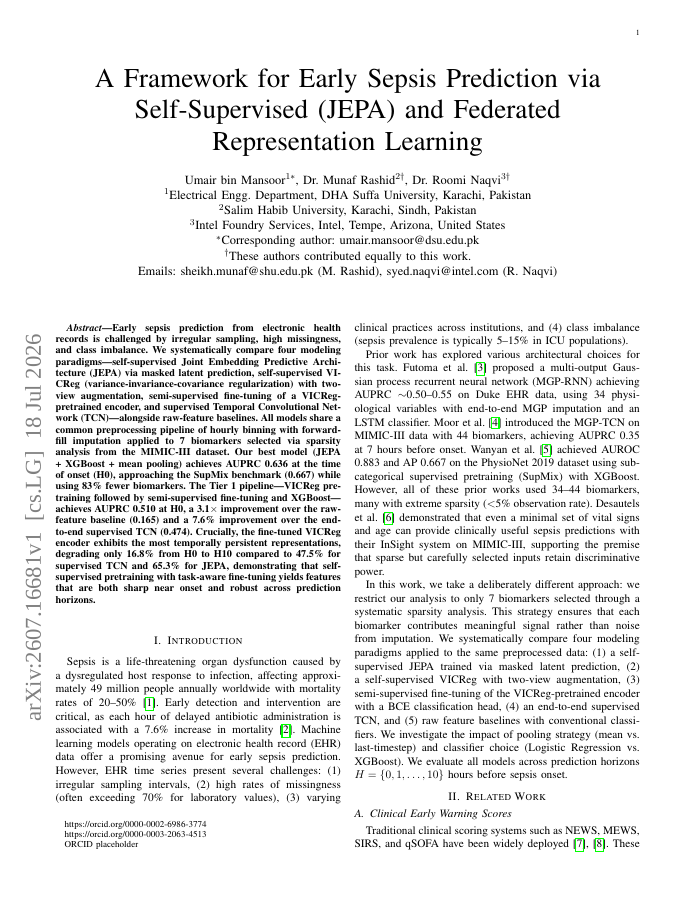
Early sepsis prediction from electronic health records is challenged by irregular sampling, high missingness, and class imbalance. We systematically compare four modeling paradigms -- self-supervised Joint Embedding Predictive Architecture (JEPA) via masked latent prediction, self-supervised VICReg (variance-invariance-covariance regularization) with two-view augmentation, semi-supervised fine-tuning of a VICReg-pretrained encoder, and supervised Temporal Convolutional Network (TCN) -- alongside raw-feature baselines. All models share a common preprocessing pipeline of hourly binning with forward-fill imputation applied to 7 biomarkers selected via sparsity analysis from the MIMIC-III dataset. Our best model (JEPA + XGBoost + mean pooling) achieves AUPRC 0.636 at the time of onset (H0), approaching the SupMix benchmark (0.667) while using 83% fewer biomarkers. The Tier 1 pipeline -- VICReg pretraining followed by semi-supervised fine-tuning and XGBoost -- achieves AUPRC 0.510 at H0, a 3.1\times improvement over the raw-feature baseline (0.165) and a 7.6% improvement over the end-to-end supervised TCN (0.474). Crucially, the fine-tuned VICReg encoder exhibits the most temporally persistent representations, degrading only 16.8% from H0 to H10 compared to 47.5% for supervised TCN and 65.3% for JEPA, demonstrating that self-supervised pretraining with task-aware fine-tuning yields features that are both sharp near onset and robust across prediction horizons.
A Framework for Early Sepsis Prediction via Self-Supervised (JEPA) and Federated Representation Learning
Early sepsis prediction from electronic health records is challenged by irregular sampling, high missingness, and class imbalance. We systematically compare four modeling paradigms -- self-supervised Joint Embedding Predictive Architecture (JEPA) via masked latent prediction,…
- Preview
- Year
- 2026
- Hosting
- Excerpt onlyCC-BY-NC-SA-4.0
Cite
Notes
Only stored in your browser.
Attribution
- Abstract & full text
- arxiv.org/abs/2607.16681CC-BY-NC-SA-4.0
- TL;DR
- Semantic Scholar