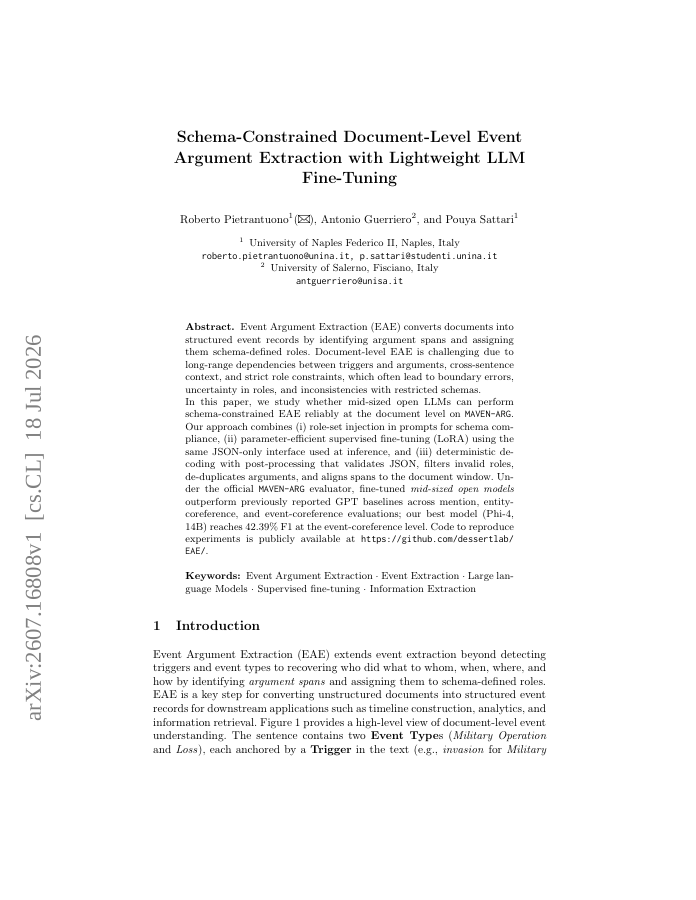
Event Argument Extraction (EAE) converts documents into structured event records by identifying argument spans and assigning them schema-defined roles. Document-level EAE is challenging due to long-range dependencies between triggers and arguments, cross-sentence context, and strict role constraints, which often lead to boundary errors, uncertainty in roles, and inconsistencies with restricted schemas. In this paper, we study whether mid-sized open LLMs can perform schema-constrained EAE reliably at the document level on MAVEN-ARG. Our approach combines (i) role-set injection in prompts for schema compliance, (ii) parameter-efficient supervised fine-tuning (LoRA) using the same JSON-only interface used at inference, and (iii) deterministic decoding with post-processing that validates JSON, filters invalid roles, de-duplicates arguments, and aligns spans to the document window. Under the official MAVEN-ARG evaluator, fine-tuned mid-sized open models outperform previously reported GPT baselines across mention, entity-coreference, and event-coreference evaluations; our best model (Phi-4, 14B) reaches 42.39% F1 at the event-coreference level. Code to reproduce experiments is publicly available at https://github.com/dessertlab/EAE/.
Schema-Constrained Document-Level Event Argument Extraction with Lightweight LLM Fine-Tuning
Event Argument Extraction (EAE) converts documents into structured event records by identifying argument spans and assigning them schema-defined roles. Document-level EAE is challenging due to long-range dependencies between triggers and arguments, cross-sentence context, and…
- Preview
- Year
- 2026
- Hosting
- Excerpt onlyCC-BY-NC-SA-4.0
Cite
Notes
Only stored in your browser.
Attribution
- Abstract & full text
- arxiv.org/abs/2607.16808CC-BY-NC-SA-4.0
- TL;DR
- Semantic Scholar