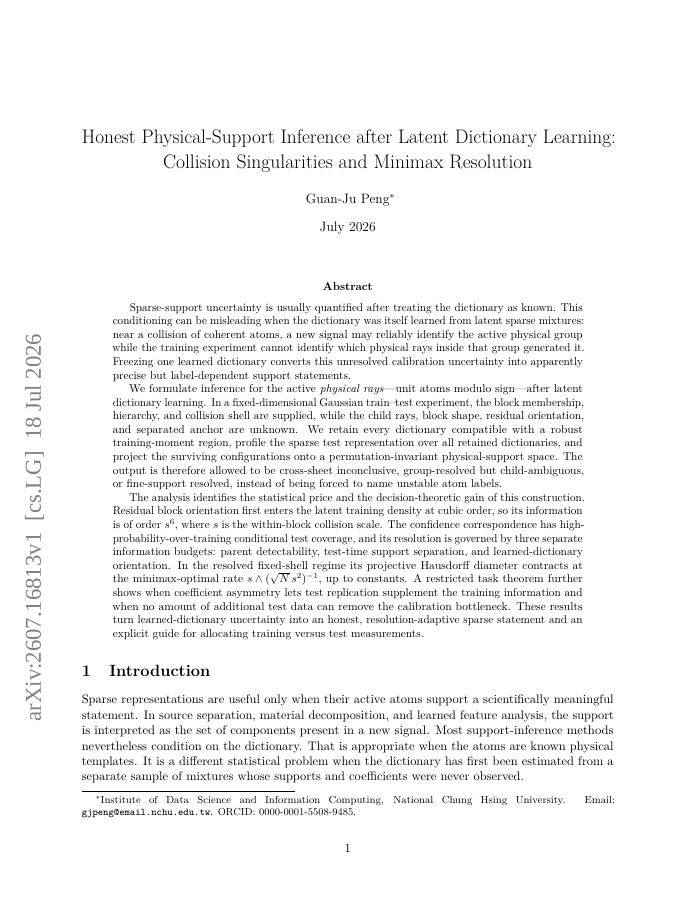
Sparse-support uncertainty is usually quantified by treating the dictionary as known, an assumption that can produce overconfident, label-dependent conclusions when the dictionary is learned from latent sparse mixtures. Near collisions of coherent atoms, a test signal may identify the active physical group even though the training data cannot distinguish the physical rays within it. We develop inference for active physical rays, unit atoms modulo sign, after latent dictionary learning. In a fixed-dimensional Gaussian train-test experiment, we retain all dictionaries compatible with a robust training-moment region, profile the test representation over them, and project surviving configurations onto a permutation-invariant support space. The resulting confidence correspondence can report cross-sheet inconclusiveness, group resolution with child ambiguity, or fine-support resolution. We characterize both its statistical cost and decision-theoretic benefit. Residual block orientation first affects the latent training density at cubic order, yielding information of order s^6, where s is the within-block collision scale. The correspondence provides high-probability-over-training conditional test coverage, with resolution governed separately by parent detectability, test-time support separation, and learned-dictionary orientation. In the resolved fixed-shell regime, its projective Hausdorff diameter contracts at the minimax-optimal rate s \wedge (\sqrt{N}s^2)^{-1}, up to constants. A restricted-task theorem further determines when coefficient asymmetry allows test replication to supplement training information and when calibration uncertainty remains irreducible. The framework thus yields honest, resolution-adaptive support statements and guides the allocation of training versus test measurements.
Honest Physical-Support Inference after Latent Dictionary Learning: Collision Singularities and Minimax Resolution
Sparse-support uncertainty is usually quantified by treating the dictionary as known, an assumption that can produce overconfident, label-dependent conclusions when the dictionary is learned from latent sparse mixtures.
- Preview
- Year
- 2026
- Hosting
- Full text hostedCC-BY-4.0
Cite
Notes
Only stored in your browser.
Attribution
- Abstract & full text
- arxiv.org/abs/2607.16813CC-BY-4.0
- TL;DR
- Semantic Scholar