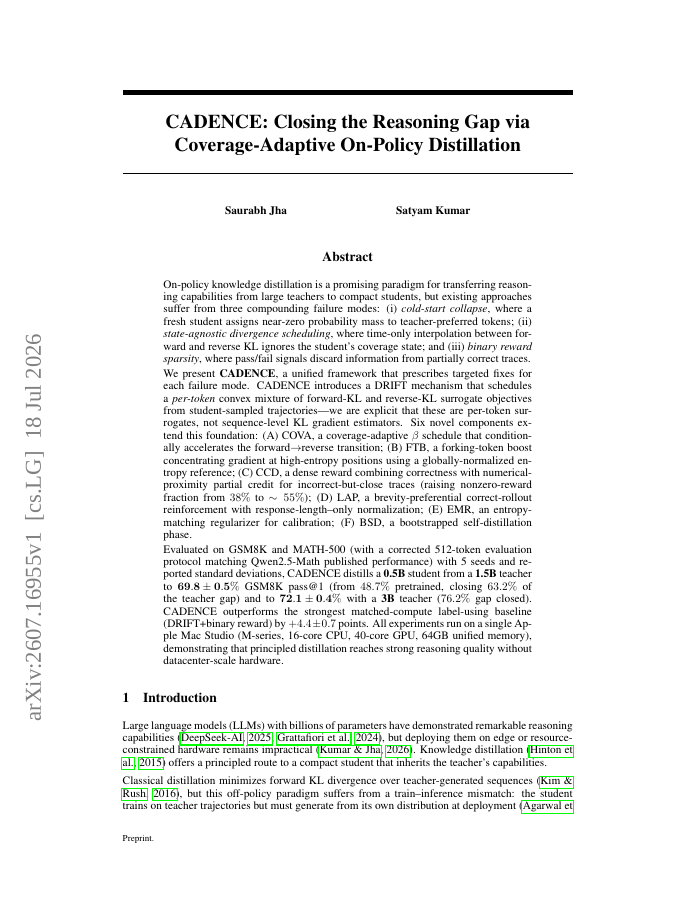
On-policy knowledge distillation transfers reasoning from large teachers to compact students, but existing approaches suffer three compounding failure modes: (i) cold-start collapse, where a fresh student assigns near-zero mass to teacher-preferred tokens; (ii) state-agnostic divergence scheduling, where time-only forward/reverse-KL interpolation ignores the student's coverage state; and (iii) binary reward sparsity, where pass/fail signals discard information from partially correct traces. We present CADENCE, a unified framework with a targeted fix for each. Its DRIFT mechanism schedules a per-token convex mixture of forward-KL and reverse-KL surrogate objectives on student-sampled trajectories (per-token surrogates, not sequence-level KL gradient estimators). Six components extend it: (A) COVA, a coverage-adaptive β schedule accelerating the forward-to-reverse transition; (B) FTB, a forking-token boost concentrating gradient at high-entropy positions via a globally-normalized entropy reference; (C) CCD, a dense reward adding numerical-proximity partial credit for incorrect-but-close traces; (D) LAP, brevity-preferential correct-rollout reinforcement; (E) EMR, an entropy-matching calibration regularizer; (F) BSD, a bootstrapped self-distillation phase. On GSM8K and MATH-500 (corrected 512-token protocol, 5 seeds, reported std), CADENCE distills a 0.5B student from a 1.5B teacher to 69.8 \pm 0.5% GSM8K pass@1 (from 48.7% pretrained; 63.2% of the teacher gap closed) and to 72.1 \pm 0.4% with a 3B teacher (76.2% closed), beating the strongest matched-compute label-using baseline (DRIFT+binary reward) by +4.4 \pm 0.7 points. All experiments run on a single Apple Mac Studio (M-series, 64GB unified memory), showing principled distillation reaches strong reasoning quality without datacenter-scale hardware.
CADENCE: Closing the Reasoning Gap via Coverage-Adaptive On-Policy Distillation
On-policy knowledge distillation transfers reasoning from large teachers to compact students, but existing approaches suffer three compounding failure modes: (i) cold-start collapse, where a fresh student assigns near-zero mass to teacher-preferred tokens; (ii) state-agnostic…
- Preview
- Year
- 2026
- Hosting
- Abstract onlyARXIV-DEFAULT
Cite
Notes
Only stored in your browser.
Attribution
- Abstract & full text
- arxiv.org/abs/2607.16955ARXIV-DEFAULT
- TL;DR
- Semantic Scholar