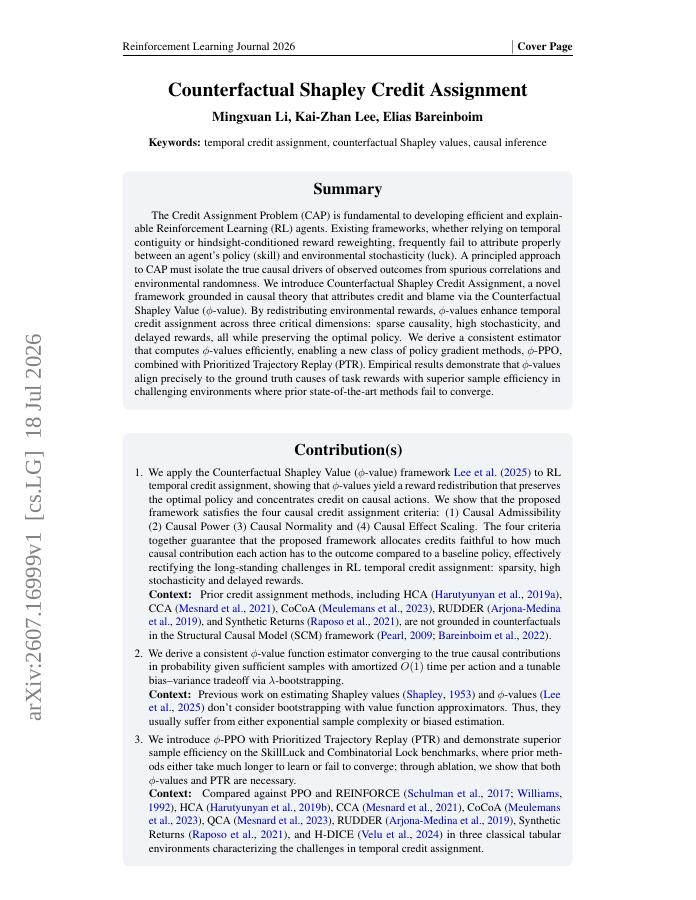
The Credit Assignment Problem (CAP) is fundamental to developing efficient and explainable Reinforcement Learning (RL) agents. Existing frameworks, whether relying on temporal contiguity or hindsight-conditioned reward reweighting, frequently fail to attribute properly between an agent's policy (skill) and environmental stochasticity (luck). A principled approach to CAP must isolate the true causal drivers of observed outcomes from spurious correlations and environmental randomness. We introduce Counterfactual Shapley Credit Assignment, a novel framework grounded in causal theory that attributes credit and blame via the Counterfactual Shapley Value (ϕ-value). By redistributing environmental rewards, ϕ-values enhance temporal credit assignment across three critical dimensions: sparse causality, high stochasticity, and delayed rewards, all while preserving the optimal policy. We derive a consistent estimator that computes ϕ-values efficiently, enabling a new class of policy gradient methods, ϕ-PPO, combined with Prioritized Trajectory Replay (PTR). Empirical results demonstrate that ϕ-values align precisely to the ground truth causes of task rewards with superior sample efficiency in challenging environments where prior state-of-the-art methods fail to converge.
Counterfactual Shapley Credit Assignment
The Credit Assignment Problem (CAP) is fundamental to developing efficient and explainable Reinforcement Learning (RL) agents. Existing frameworks, whether relying on temporal contiguity or hindsight-conditioned reward reweighting, frequently fail to attribute properly between…
- Preview
- Year
- 2026
- Hosting
- Full text hostedCC-BY-SA-4.0
Cite
Notes
Only stored in your browser.
Attribution
- Abstract & full text
- arxiv.org/abs/2607.16999CC-BY-SA-4.0
- TL;DR
- Semantic Scholar