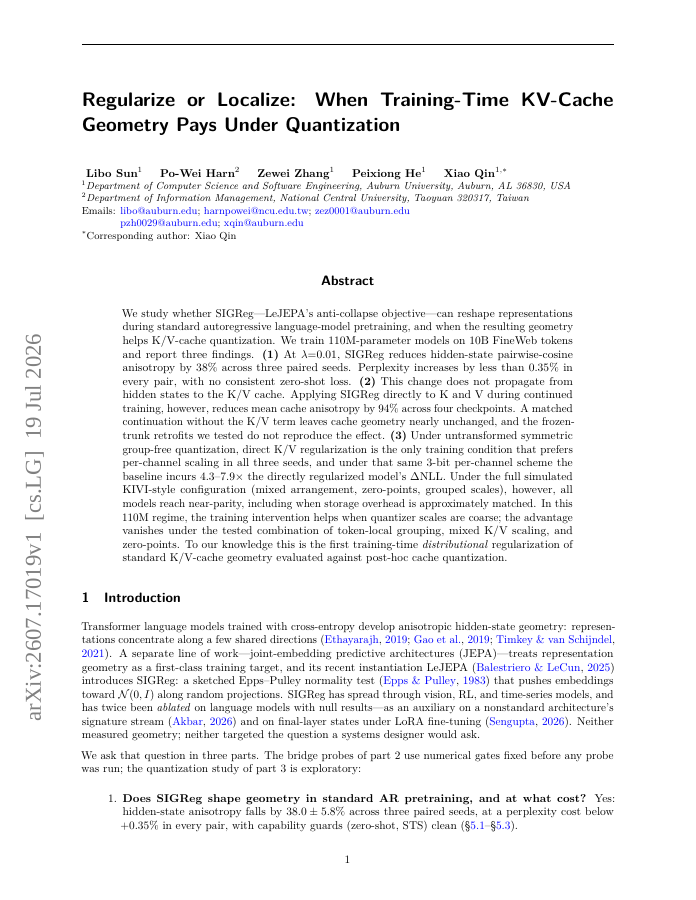
We study whether \sigreg -- LeJEPA's anti-collapse objective -- can reshape representations during standard autoregressive language-model pretraining, and when the resulting geometry helps \kv-cache quantization. We train 110M-parameter models on 10B FineWeb tokens and report three findings. (1) At λ{=}0.01, \sigreg reduces hidden-state pairwise-cosine anisotropy by 38% across three paired seeds. Perplexity increases by less than 0.35% in every pair, with no consistent zero-shot loss. (2) This change does not propagate from hidden states to the \kv cache. Applying \sigreg directly to K and V during continued training, however, reduces mean cache anisotropy by 94% across four checkpoints. A matched continuation without the \kv term leaves cache geometry nearly unchanged, and the frozen-trunk retrofits we tested do not reproduce the effect. (3) Under untransformed symmetric group-free quantization, direct \kv regularization is the only training condition that prefers per-channel scaling in all three seeds, and under that same 3-bit per-channel scheme the baseline incurs 4.3--7.9\times the directly regularized model's \dnll. Under the full simulated KIVI-style configuration (mixed arrangement, zero-points, grouped scales), however, all models reach near-parity, including when storage overhead is approximately matched. In this 110M regime, the training intervention helps when quantizer scales are coarse; the advantage vanishes under the tested combination of token-local grouping, mixed \kv scaling, and zero-points. To our knowledge this is the first training-time distributional regularization of standard \kv-cache geometry evaluated against post-hoc cache quantization.
Regularize or Localize: When Training-Time KV-Cache Geometry Pays Under Quantization
We study whether \sigreg -- LeJEPA's anti-collapse objective -- can reshape representations during standard autoregressive language-model pretraining, and when the resulting geometry helps \kv-cache quantization.
- Preview
- Year
- 2026
- Hosting
- Full text hostedCC-BY-4.0
Cite
Notes
Only stored in your browser.
Attribution
- Abstract & full text
- arxiv.org/abs/2607.17019CC-BY-4.0
- TL;DR
- Semantic Scholar