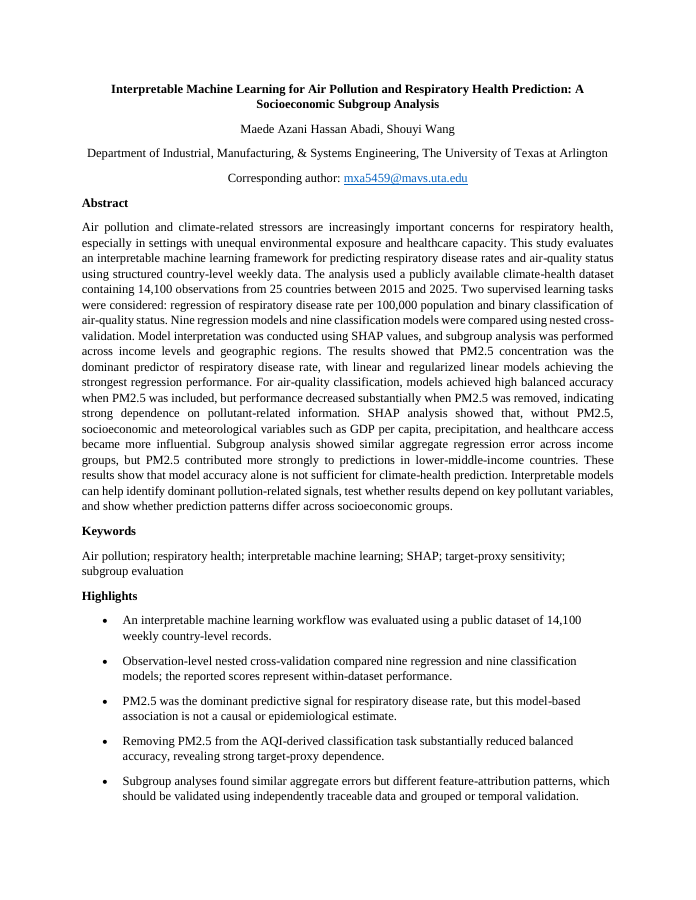
Air pollution and climate-related stressors are increasingly important concerns for respiratory health, especially in settings with unequal environmental exposure and healthcare capacity. This study evaluates an interpretable machine learning framework for predicting respiratory disease rates and air-quality status using structured country-level weekly data. Two supervised learning tasks were considered: regression of respiratory disease rate per 100,000 population and binary classification of air-quality status. Nine regression models and nine classification models were compared using nested cross-validation. Model interpretation was conducted using SHAP values, and subgroup analysis was performed across income levels and geographic regions. The results showed that PM2.5 concentration was the dominant predictor of respiratory disease rate, with linear and regularized linear models achieving the strongest regression performance. For air-quality classification, models achieved high balanced accuracy when PM2.5 was included, but performance decreased substantially when PM2.5 was removed, indicating strong dependence on pollutant-related information. SHAP analysis showed that, without PM2.5, socioeconomic and meteorological variables such as GDP per capita, precipitation, and healthcare access became more influential. Subgroup analysis showed similar aggregate regression error across income groups, but PM2.5 contributed more strongly to predictions in lower-middle-income countries. These results show that model accuracy alone is not sufficient for climate-health prediction. Interpretable models can help identify dominant pollution-related signals, test whether results depend on key pollutant variables, and show whether prediction patterns differ across socioeconomic groups.
Interpretable Machine Learning for Air Pollution and Respiratory Health Prediction: A Socioeconomic Subgroup Analysis
Air pollution and climate-related stressors are increasingly important concerns for respiratory health, especially in settings with unequal environmental exposure and healthcare capacity.
- Preview
- Year
- 2026
- Hosting
- Abstract onlyARXIV-DEFAULT
Cite
Notes
Only stored in your browser.
Attribution
- Abstract & full text
- arxiv.org/abs/2607.17024ARXIV-DEFAULT
- TL;DR
- Semantic Scholar