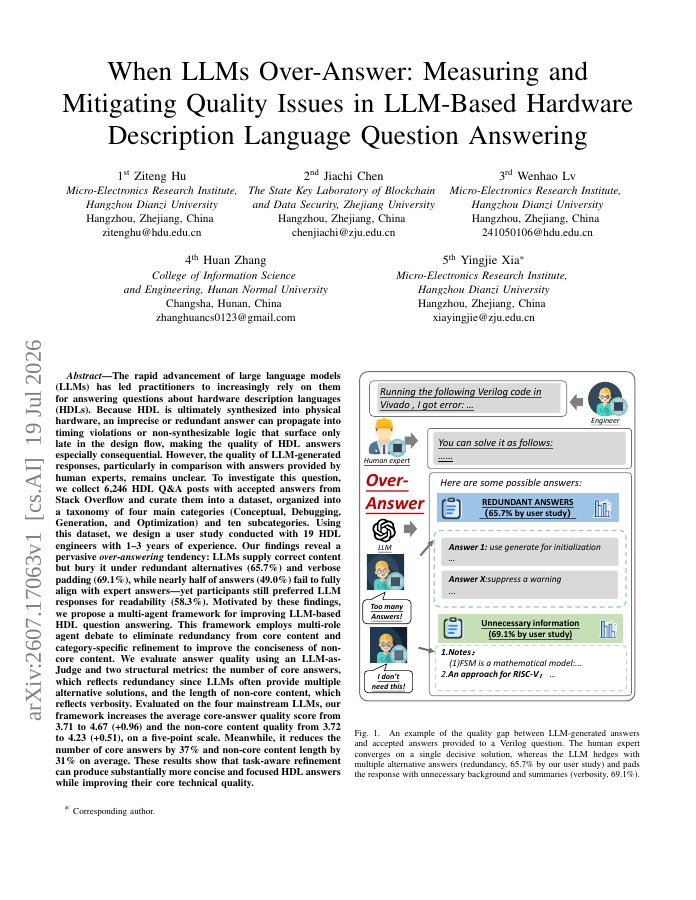
The rapid advancement of large language models (LLMs) has led practitioners to increasingly rely on them for answering questions about hardware description languages (HDLs). Because HDL is ultimately synthesized into physical hardware, an imprecise or redundant answer can propagate into timing violations or non-synthesizable logic that surface only late in the design flow, making the quality of HDL answers especially consequential. However, the quality of LLM-generated responses, particularly in comparison with answers provided by human experts, remains unclear. To investigate this question, we collect 6,246 HDL Q&A posts with accepted answers from Stack Overflow and curate them into a dataset, organized into a taxonomy of four main categories (Conceptual, Debugging, Generation, and Optimization) and ten subcategories. Using this dataset, we design a user study conducted with 19 HDL engineers with one to three years of experience. Our findings reveal a pervasive over answering tendency: LLMs supply correct content but bury it under redundant alternatives (65.7%) and verbose padding (69.1%), while nearly half of answers (49.0%) fail to fully align with expert answers yet participants still preferred LLM responses for readability (58.3%). Motivated by these findings, we propose a multi-agent framework for improving LLM-based HDL question answering. We evaluate answer quality using an LLM-as-Judge and two structural metrics: the number of core answers, which reflects redundancy since LLMs often provide multiple alternative solutions, and the length of non-core content, which reflects verbosity. Evaluated on the four mainstream LLMs, our framework increases the average core-answer quality score from 3.71 to 4.67 (+0.96) and the non-core content quality from 3.72 to 4.23 (+0.51), on a five-point scale.
When LLMs Over-Answer: Measuring and Mitigating Quality Issues in LLM-Based Hardware Description Language Question Answering
The rapid advancement of large language models (LLMs) has led practitioners to increasingly rely on them for answering questions about hardware description languages (HDLs).
- Preview
- Year
- 2026
- Hosting
- Abstract onlyARXIV-DEFAULT
Cite
Notes
Only stored in your browser.
Attribution
- Abstract & full text
- arxiv.org/abs/2607.17063ARXIV-DEFAULT
- TL;DR
- Semantic Scholar