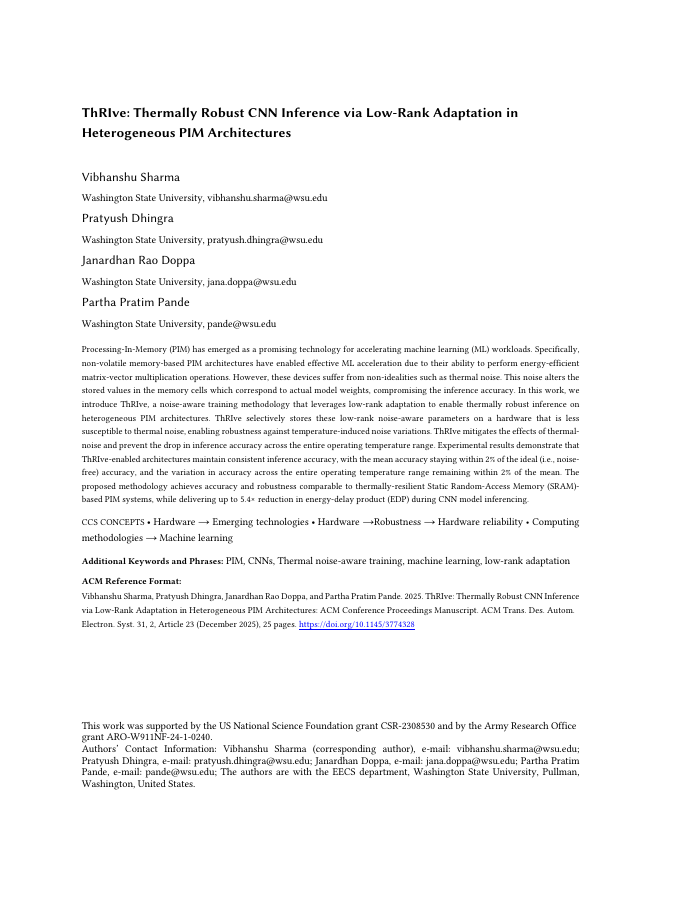
Processing-In-Memory (PIM) has emerged as a promising technology for accelerating machine learning (ML) workloads. Specifically, non-volatile memory-based PIM architectures have enabled effective ML acceleration due to their ability to perform energy-efficient matrix-vector multiplication operations. However, these devices suffer from non-idealities such as thermal noise. This noise alters the stored values in the memory cells which correspond to actual model weights, compromising the inference accuracy. In this work, we introduce ThRIve, a noise-aware training methodology that leverages low-rank adaptation to enable thermally robust inference on heterogeneous PIM architectures. ThRIve selectively stores these low-rank noise-aware parameters on a hardware that is less susceptible to thermal noise, enabling robustness against temperature-induced noise variations. ThRIve mitigates the effects of thermal-noise and prevent the drop in inference accuracy across the entire operating temperature range. Experimental results demonstrate that ThRIve-enabled architectures maintain consistent inference accuracy, with the mean accuracy staying within 2% of the ideal (i.e., noise-free) accuracy, and the variation in accuracy across the entire operating temperature range remaining within 2% of the mean. The proposed methodology achieves accuracy and robustness comparable to thermally-resilient Static Random-Access Memory (SRAM)-based PIM systems, while delivering up to 5.4x reduction in energy-delay product (EDP) during CNN model inferencing.
ThRIve: Thermally Robust CNN Inference via Low-Rank Adaptation in Heterogeneous PIM Architectures
Processing-In-Memory (PIM) has emerged as a promising technology for accelerating machine learning (ML) workloads. Specifically, non-volatile memory-based PIM architectures have enabled effective ML acceleration due to their ability to perform energy-efficient matrix-vector…
- Preview
- Year
- 2026
- Hosting
- Full text hostedCC-BY-4.0
Cite
Notes
Only stored in your browser.
Attribution
- Abstract & full text
- arxiv.org/abs/2607.17091CC-BY-4.0
- TL;DR
- Semantic Scholar