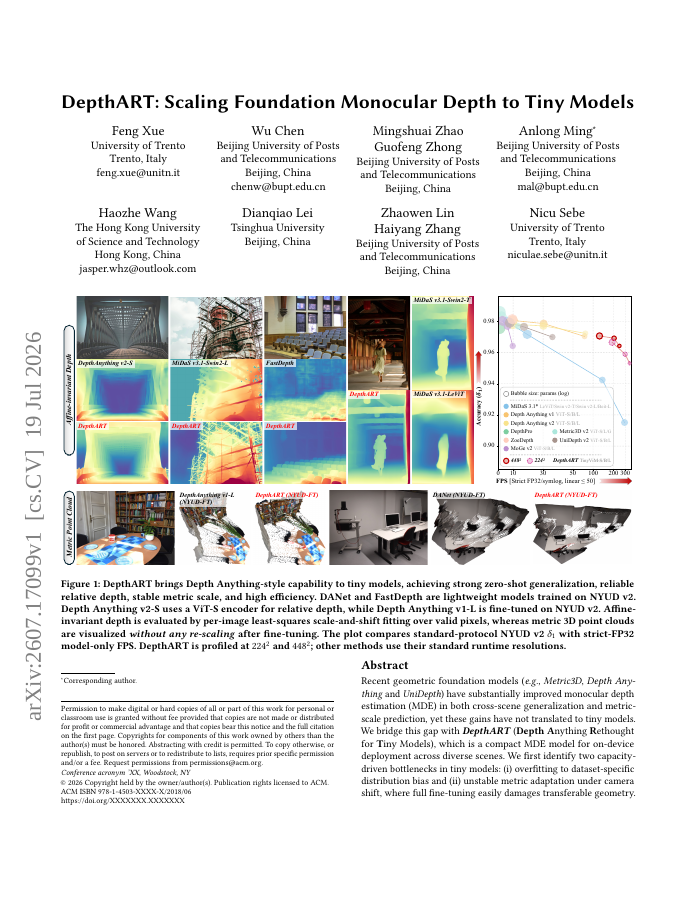
Recent geometric foundation models (e.g., Metric3D, Depth Anything and UniDepth) have substantially improved monocular depth estimation (MDE) in both cross-scene generalization and metric-scale prediction, yet these gains have not translated to tiny models. We bridge this gap with DepthART (Depth Anything Rethought for Tiny Models), which is a compact MDE model for on-device deployment across diverse scenes. We first identify two capacity-driven bottlenecks in tiny models: (i) overfitting to dataset-specific distribution bias and (ii) unstable metric adaptation under camera shift, where full fine-tuning easily damages transferable geometry. Accordingly, DepthART combines two simple but effective strategies: a bias-resistant data sampling scheme to reduce distribution bias under the same training budget, and a camera-conditioned fine-tuning protocol that freezes the distilled encoder and adjusts metric scale conditioned on intrinsics while better preserving cross-dataset generalization. Across datasets, DepthART consistently surpasses previous tiny baselines in both zero-shot generalization and metric accuracy (e.g., zero-shot δ_1=0.964 for DepthART-S on NYUD v2), and in some cases approaches heavy models. We further provide a scalable model family, with DepthART-S reaching 347/245 FPS (strict FP32) on an RTX A6000 at 224^2/448^2, 102 FPS (TF32) on a Orin NX 8GB, and over 15 FPS (FP32) on a Jetson Nano 4GB.
DepthART: Scaling Foundation Monocular Depth to Tiny Models
Recent geometric foundation models (e.g., Metric3D, Depth Anything and UniDepth) have substantially improved monocular depth estimation (MDE) in both cross-scene generalization and metric-scale prediction, yet these gains have not translated to tiny models.
- Preview
- Year
- 2026
- Hosting
- Abstract onlyARXIV-DEFAULT
Cite
Notes
Only stored in your browser.
Attribution
- Abstract & full text
- arxiv.org/abs/2607.17099ARXIV-DEFAULT
- TL;DR
- Semantic Scholar