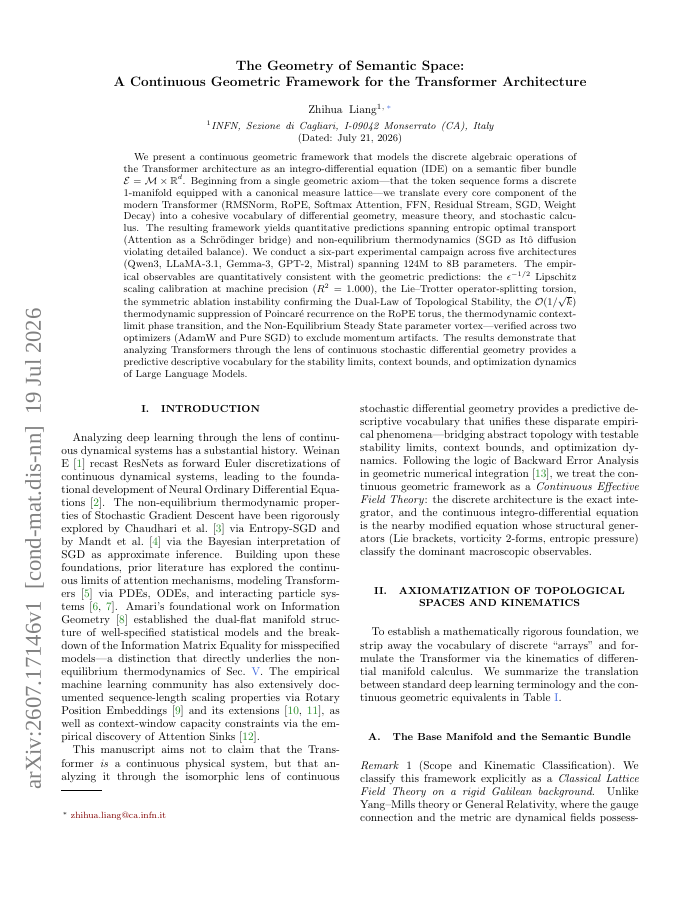
We present a continuous geometric framework that models the discrete algebraic operations of the Transformer architecture as an integro-differential equation (IDE) on a semantic fiber bundle \calE = \calM \times \R^d. Beginning from a single geometric axiom -- that the token sequence forms a discrete 1-manifold equipped with a canonical measure lattice -- we translate every core component of the modern Transformer (RMSNorm, RoPE, Softmax Attention, FFN, Residual Stream, SGD, Weight Decay) into a cohesive vocabulary of differential geometry, measure theory, and stochastic calculus. The resulting framework yields quantitative predictions spanning entropic optimal transport (Attention as a Schrödinger bridge) and non-equilibrium thermodynamics (SGD as Itô diffusion violating detailed balance). We conduct a six-part experimental campaign across five architectures (Qwen3, LLaMA\nobreakdash-3.1, Gemma\nobreakdash-3, GPT-2, Mistral) spanning 124M to 8B parameters. The empirical observables are quantitatively consistent with the geometric predictions: the ε^{-1/2} Lipschitz scaling calibration at machine precision (R^2 = 1.000), the Lie--Trotter operator-splitting torsion, the symmetric ablation instability confirming the Dual-Law of Topological Stability, the \calO(1/\sqrt{k}) thermodynamic suppression of Poincaré recurrence on the RoPE torus, the thermodynamic context-limit phase transition, and the Non-Equilibrium Steady State parameter vortex -- verified across two optimizers (AdamW and Pure SGD) to exclude momentum artifacts. The results demonstrate that analyzing Transformers through the lens of continuous stochastic differential geometry provides a predictive descriptive vocabulary for the stability limits, context bounds, and optimization dynamics of Large Language Models.
The Geometry of Semantic Space: A Continuous Geometric Framework for the Transformer Architecture
We present a continuous geometric framework that models the discrete algebraic operations of the Transformer architecture as an integro-differential equation (IDE) on a semantic fiber bundle $\calE = \calM \times \R^d$.
- Preview
- Year
- 2026
- Hosting
- Abstract onlyARXIV-DEFAULT
Cite
Notes
Only stored in your browser.
Attribution
- Abstract & full text
- arxiv.org/abs/2607.17146ARXIV-DEFAULT
- TL;DR
- Semantic Scholar