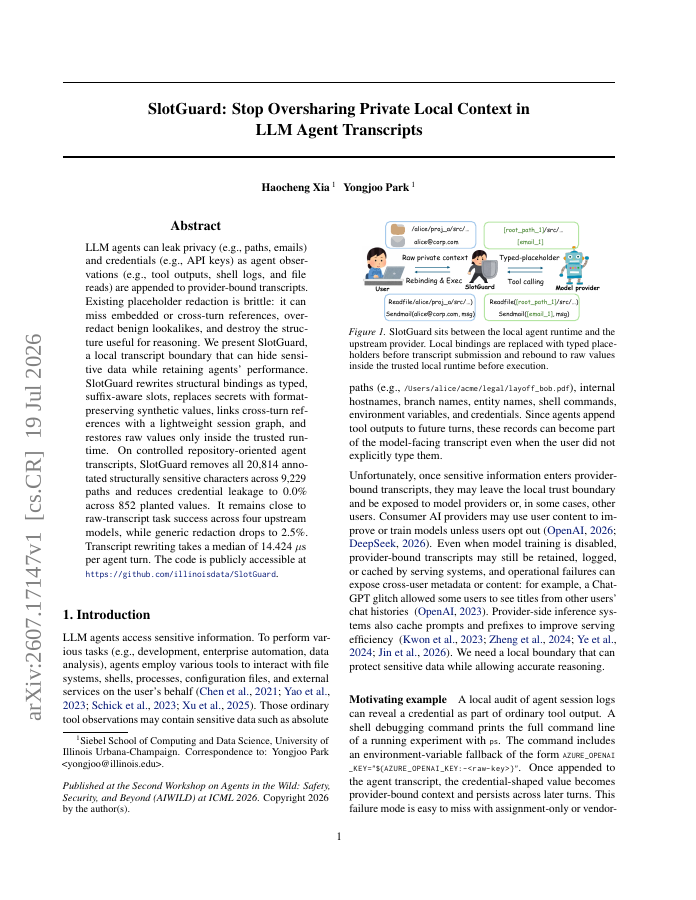
LLM agents can leak privacy (e.g., paths, emails) and credentials (e.g., API keys) as agent observations (e.g., tool outputs, shell logs, and file reads) are appended to provider-bound transcripts. Existing placeholder redaction is brittle: it can miss embedded or cross-turn references, over-redact benign lookalikes, and destroy the structure useful for reasoning. We present SlotGuard, a local transcript boundary that can hide sensitive data while retaining agents' performance. SlotGuard rewrites structural bindings as typed, suffix-aware slots, replaces secrets with format-preserving synthetic values, links cross-turn references with a lightweight session graph, and restores raw values only inside the trusted runtime. On controlled repository-oriented agent transcripts, SlotGuard removes all 20,814 annotated structurally sensitive characters across 9,229 paths and reduces credential leakage to 0.0% across 852 planted values. It remains close to raw-transcript task success across four upstream models, while generic redaction drops to 2.5%. Transcript rewriting takes a median of 14.424 μs per agent turn. The code is publicly accessible at https://github.com/illinoisdata/SlotGuard.
SlotGuard: Stop Oversharing Private Local Context in LLM Agent Transcri
LLM agents can leak privacy (e.g., paths, emails) and credentials (e.g., API keys) as agent observations (e.g., tool outputs, shell logs, and file reads) are appended to provider-bound transcripts.
- Preview
- Year
- 2026
- Hosting
- Full text hostedCC-BY-4.0
Cite
Notes
Only stored in your browser.
Attribution
- Abstract & full text
- arxiv.org/abs/2607.17147CC-BY-4.0
- TL;DR
- Semantic Scholar