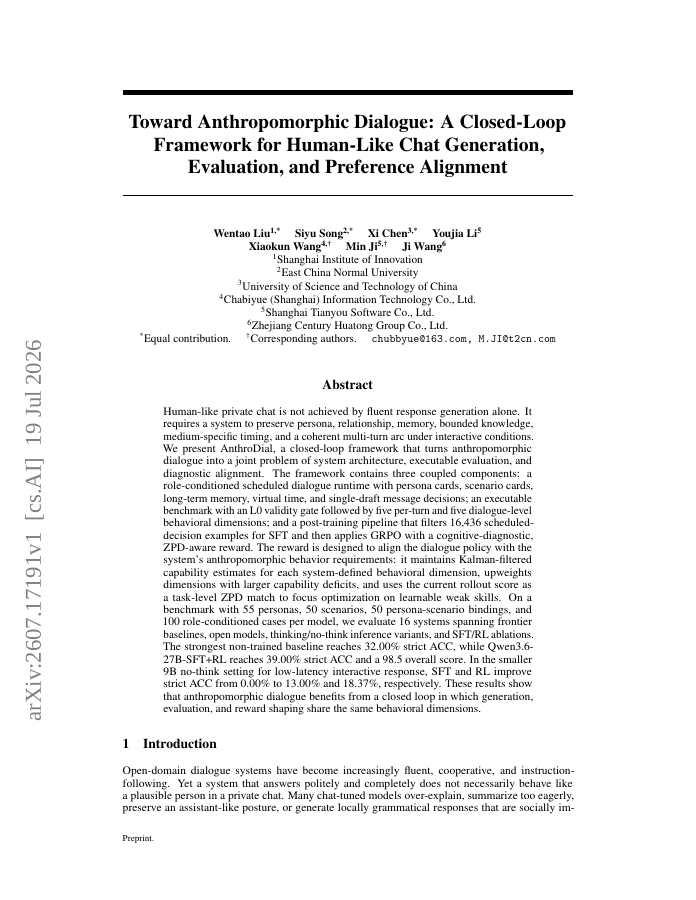
Human-like private chat requires more than fluent response generation: a system must preserve persona, relationship, memory, bounded knowledge, medium-specific timing, and a coherent multi-turn arc. We present AnthroDial, a closed-loop framework that formulates anthropomorphic dialogue as a joint problem of system architecture, executable evaluation, and diagnostic alignment. It combines (1) a role-conditioned scheduled dialogue runtime with persona and scenario cards, long-term memory, virtual time, and single-draft message decisions; (2) an executable benchmark with an L0 validity gate, five per-turn dimensions, and five dialogue-level dimensions; and (3) a post-training pipeline that filters 16,436 scheduled-decision examples for SFT and applies GRPO with a cognitive-diagnostic, ZPD-aware reward. The reward maintains Kalman-filtered capability estimates for each behavioral dimension, upweights dimensions with larger capability deficits, and uses rollout scores as task-level ZPD matches to focus optimization on learnable weak skills. On a benchmark with 55 personas, 50 scenarios, 50 persona-scenario bindings, and 100 role-conditioned cases per model, we evaluate 16 systems spanning frontier baselines, open models, thinking/no-think variants, and SFT/RL ablations. The strongest non-trained baseline reaches 32.00% strict ACC, while Qwen3.6-27B-SFT+RL reaches 39.00% strict ACC and a 98.5 overall score. In the 9B no-think setting, SFT and RL improve strict ACC from 0.00% to 13.00% and 18.37%. These results show that anthropomorphic dialogue benefits when generation, evaluation, and reward shaping share the same behavioral dimensions.
Toward Anthropomorphic Dialogue: A Closed-Loop Framework for Human-Like Chat Generation, Evaluation, and Preference Alignment
Human-like private chat requires more than fluent response generation: a system must preserve persona, relationship, memory, bounded knowledge, medium-specific timing, and a coherent multi-turn arc.
- Preview
- Year
- 2026
- Hosting
- Full text hostedCC-BY-4.0
Cite
Notes
Only stored in your browser.
Attribution
- Abstract & full text
- arxiv.org/abs/2607.17191CC-BY-4.0
- TL;DR
- Semantic Scholar