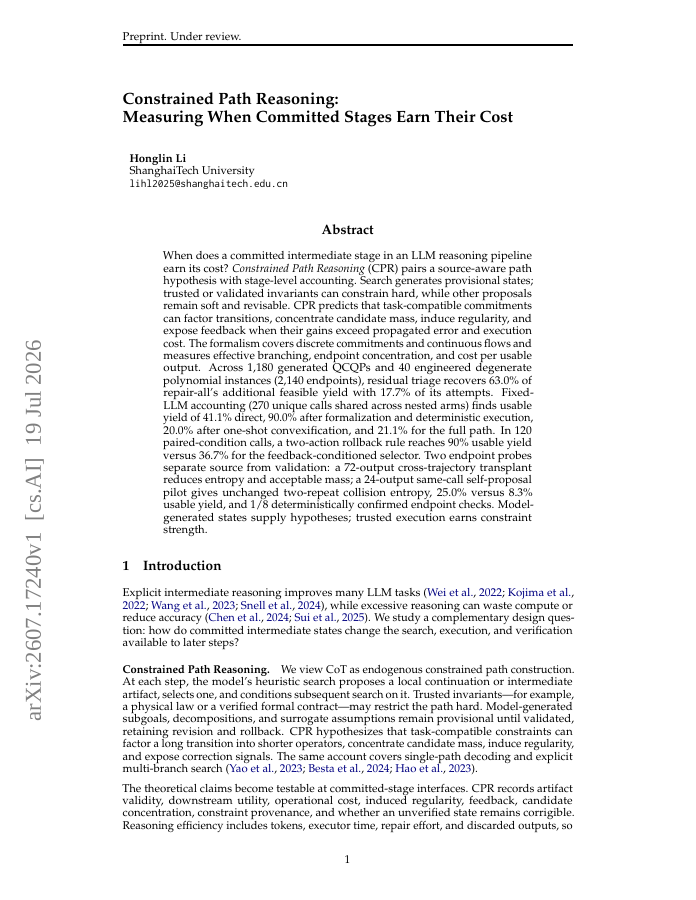
When does a committed intermediate stage in an LLM reasoning pipeline earn its cost? Constrained Path Reasoning (CPR) pairs a source-aware path hypothesis with stage-level accounting. Search generates provisional states; trusted or validated invariants can constrain hard, while other proposals remain soft and revisable. CPR predicts that task-compatible commitments can factor transitions, concentrate candidate mass, induce regularity, and expose feedback when their gains exceed propagated error and execution cost. The formalism covers discrete commitments and continuous flows and measures effective branching, endpoint concentration, and cost per usable output. Across 1,180 generated QCQPs and 40 engineered degenerate polynomial instances (2,140 endpoints), residual triage recovers 63.0% of repair-all's additional feasible yield with 17.7% of its attempts. Fixed-LLM accounting (270 unique calls shared across nested arms) finds usable yield of 41.1% direct, 90.0% after formalization and deterministic execution, 20.0% after one-shot convexification, and 21.1% for the full path. In 120 paired-condition calls, a two-action rollback rule reaches 90% usable yield versus 36.7% for the feedback-conditioned selector. Two endpoint probes separate source from validation: a 72-output cross-trajectory transplant reduces entropy and acceptable mass; a 24-output same-call self-proposal pilot gives unchanged two-repeat collision entropy, 25.0% versus 8.3% usable yield, and 1/8 deterministically confirmed endpoint checks. Model-generated states supply hypotheses; trusted execution earns constraint strength.
Constrained Path Reasoning: Measuring When Committed Stages Earn Their Cost
When does a committed intermediate stage in an LLM reasoning pipeline earn its cost? Constrained Path Reasoning (CPR) pairs a source-aware path hypothesis with stage-level accounting.
- Preview
- Year
- 2026
- Hosting
- Full text hostedCC-BY-4.0
Cite
Notes
Only stored in your browser.
Attribution
- Abstract & full text
- arxiv.org/abs/2607.17240CC-BY-4.0
- TL;DR
- Semantic Scholar