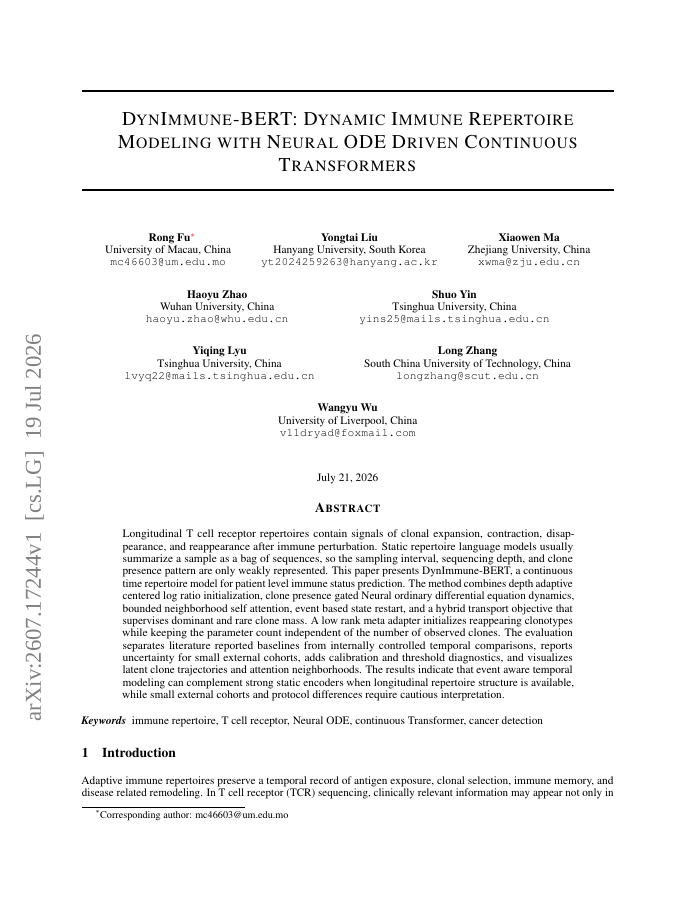
Longitudinal T cell receptor repertoires contain signals of clonal expansion, contraction, disappearance, and reappearance after immune perturbation. Static repertoire language models usually summarize a sample as a bag of sequences, so the sampling interval, sequencing depth, and clone presence pattern are only weakly represented. This paper presents DynImmune-BERT, a continuous time repertoire model for patient level immune status prediction. The method combines depth adaptive centered log ratio initialization, clone presence gated Neural ordinary differential equation dynamics, bounded neighborhood self attention, event based state restart, and a hybrid transport objective that supervises dominant and rare clone mass. A low rank meta adapter initializes reappearing clonotypes while keeping the parameter count independent of the number of observed clones. The evaluation separates literature reported baselines from internally controlled temporal comparisons, reports uncertainty for small external cohorts, adds calibration and threshold diagnostics, and visualizes latent clone trajectories and attention neighborhoods. The results indicate that event aware temporal modeling can complement strong static encoders when longitudinal repertoire structure is available, while small external cohorts and protocol differences require cautious interpretation.
DynImmune-BERT: Dynamic Immune Repertoire Modeling with Neural ODE Driven Continuous Transformers
Longitudinal T cell receptor repertoires contain signals of clonal expansion, contraction, disappearance, and reappearance after immune perturbation. Static repertoire language models usually summarize a sample as a bag of sequences, so the sampling interval, sequencing depth,…
- Preview
- Year
- 2026
- Hosting
- Full text hostedCC-BY-4.0
Cite
Notes
Only stored in your browser.
Attribution
- Abstract & full text
- arxiv.org/abs/2607.17244CC-BY-4.0
- TL;DR
- Semantic Scholar