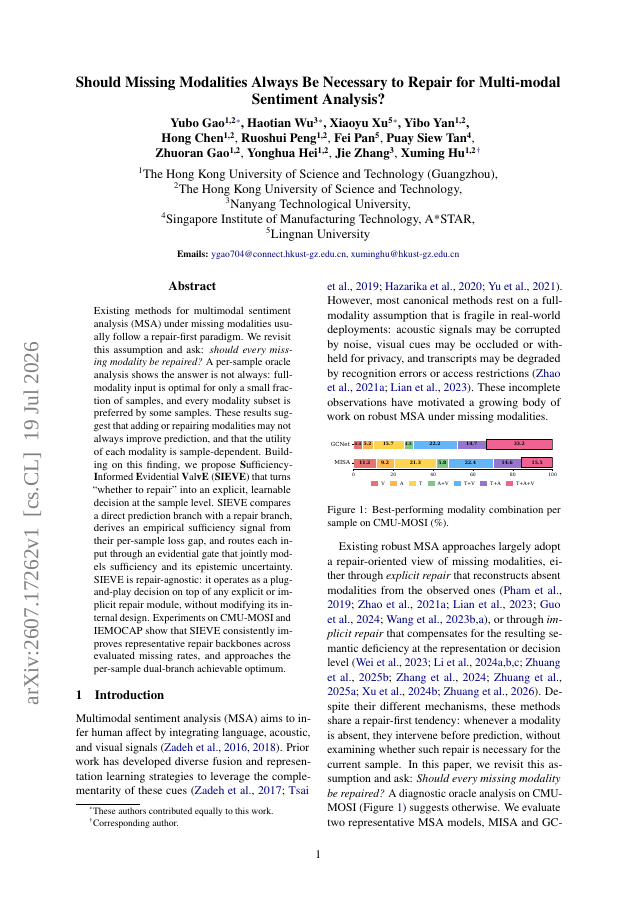
Existing methods for multimodal sentiment analysis (MSA) under missing modalities usually follow a repair-first paradigm. We revisit this assumption and ask: should every missing modality be repaired? A per-sample oracle analysis shows the answer is not always: full-modality input is optimal for only a small fraction of samples, and every modality subset is preferred by some samples. These results suggest that adding or repairing modalities may not always improve prediction, and that the utility of each modality is sample-dependent. Building on this finding, we propose Sufficiency-Informed Evidential ValvE (SIEVE) that turns ``whether to repair'' into an explicit, learnable decision at the sample level. SIEVE compares a direct prediction branch with a repair branch, derives an empirical sufficiency signal from their per-sample loss gap, and routes each input through an evidential gate that jointly models sufficiency and its epistemic uncertainty. SIEVE is repair-agnostic: it operates as a plug-and-play decision on top of any explicit or implicit repair module, without modifying its internal design. Experiments on CMU-MOSI and IEMOCAP show that SIEVE consistently improves representative repair backbones across evaluated missing rates, and approaches the per-sample dual-branch achievable optimum.
Should Missing Modalities Always Be Necessary to Repair for Multi-modal Sentiment Analysis?
Existing methods for multimodal sentiment analysis (MSA) under missing modalities usually follow a repair-first paradigm. We revisit this assumption and ask: \emph{should every missing modality be repaired?} A per-sample oracle analysis shows the answer is not always:…
- Preview
- Year
- 2026
- Hosting
- Full text hostedCC-BY-4.0
Cite
Notes
Only stored in your browser.
Attribution
- Abstract & full text
- arxiv.org/abs/2607.17262CC-BY-4.0
- TL;DR
- Semantic Scholar