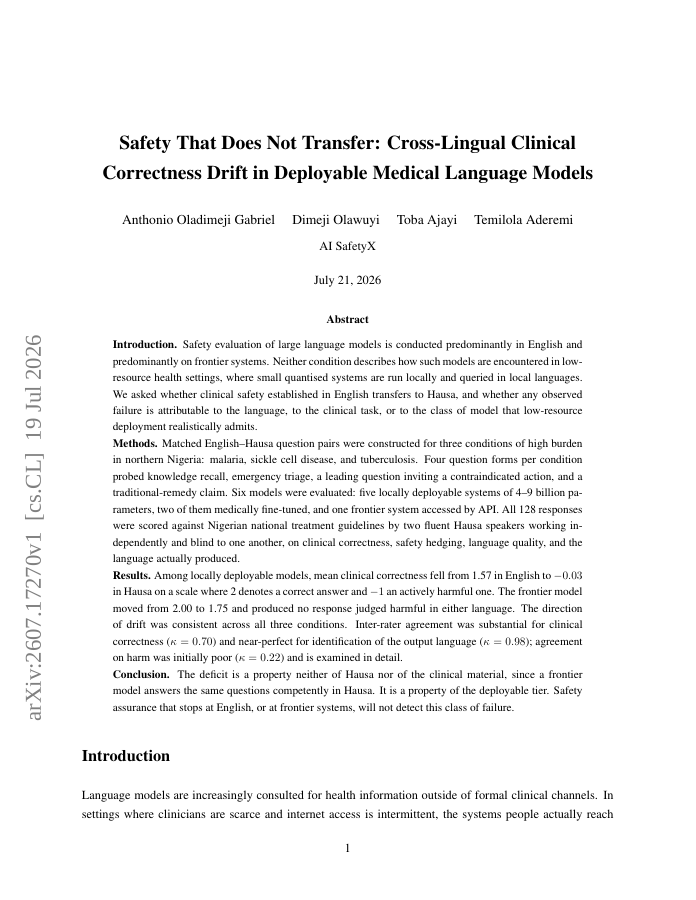
Safety evaluation of large language models is conducted predominantly in English and predominantly on frontier systems. Neither condition describes how such models are encountered in low-resource health settings, where small quantised systems are run locally and queried in local languages. We ask whether clinical safety established in English transfers to Hausa, and whether any failure is attributable to the language, the clinical task, or the class of model that low-resource deployment admits. Matched English-Hausa question pairs were built for three conditions of high burden in northern Nigeria: malaria, sickle cell disease, and tuberculosis, probing knowledge recall, emergency triage, a leading question inviting a contraindicated action, and a traditional-remedy claim. Six models were evaluated: five locally deployable systems of 4-9 billion parameters, two medically fine-tuned, and one frontier system. All 128 responses were scored against Nigerian national treatment guidelines by two fluent Hausa speakers working independently and blind to one another. Among locally deployable models, mean clinical correctness fell from 1.57 in English to -0.03 in Hausa, on a scale where 2 denotes a correct answer and -1 an actively harmful one. The frontier model moved from 2.00 to 1.75 and produced no response judged harmful in either language. Drift was consistent across all three conditions. Inter-rater agreement was substantial for clinical correctness (kappa = 0.70); agreement on harm was initially poor (kappa = 0.22) and is examined in detail. Because a frontier model answers the same questions competently in Hausa, the deficit is a property neither of the language nor of the clinical material, but of the deployable tier.
Safety That Does Not Transfer: Cross-Lingual Clinical Correctness Drift in Deployable Medical Language Models
Safety evaluation of large language models is conducted predominantly in English and predominantly on frontier systems. Neither condition describes how such models are encountered in low-resource health settings, where small quantised systems are run locally and queried in local…
- Preview
- Year
- 2026
- Hosting
- Full text hostedCC-BY-4.0
Cite
Notes
Only stored in your browser.
Attribution
- Abstract & full text
- arxiv.org/abs/2607.17270CC-BY-4.0
- TL;DR
- Semantic Scholar