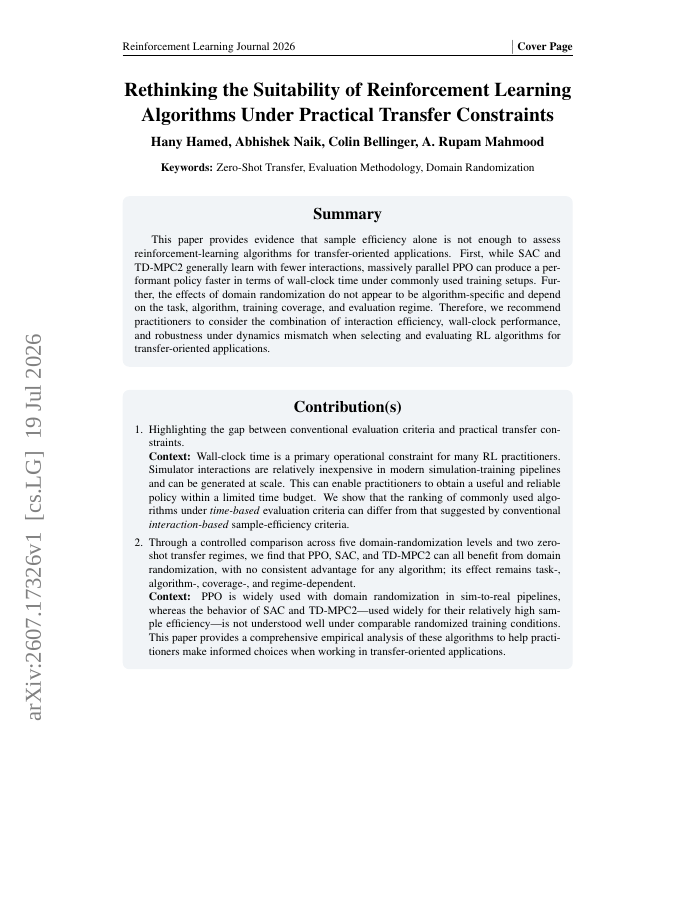
Transfer-oriented reinforcement learning requires evaluating algorithms along dimensions that go beyond standard sample efficiency. We focus on two dimensions: practical efficiency, which asks whether conclusions about algorithm suitability change under wall-clock rather than interaction-based budgets, and robustness under dynamics mismatch, which asks how different learning paradigms respond to variability in the training distribution induced by domain randomization. We provide two insights to reinforcement-learning practitioners. First, comparing the sample efficiency of different algorithms is often an insufficient criterion in transfer-oriented settings. The wall-clock time required to train a decent policy is an important consideration for practitioners, and we find that the sample-inefficient PPO algorithm can produce a performant policy faster than relatively more sample-efficient algorithms such as SAC and TD-MPC2, validating the common understanding of massively parallel training paradigms. Second, domain randomization can help different kinds of algorithms learn robust policies. In particular, although PPO, SAC, and TD-MPC2 represent different RL paradigms - on-policy, off-policy, and model-based learning and planning, respectively - we find that domain randomization affects all three algorithms in a similar way. To the best of our knowledge, this is the first controlled comparison of the effect of domain-randomization coverage on PPO, SAC, and TD-MPC2 under the same transfer protocol. Taken together, these two insights highlight the importance of evaluating RL algorithms not only by sample efficiency, but also by practical considerations such as training time and the algorithms' ability to produce usable policies.
Rethinking the Suitability of Reinforcement Learning Algorithms Under Practical Transfer Constraints
Transfer-oriented reinforcement learning requires evaluating algorithms along dimensions that go beyond standard sample efficiency. We focus on two dimensions: practical efficiency, which asks whether conclusions about algorithm suitability change under wall-clock rather than…
- Preview
- Year
- 2026
- Hosting
- Full text hostedCC-BY-4.0
Cite
Notes
Only stored in your browser.
Attribution
- Abstract & full text
- arxiv.org/abs/2607.17326CC-BY-4.0
- TL;DR
- Semantic Scholar