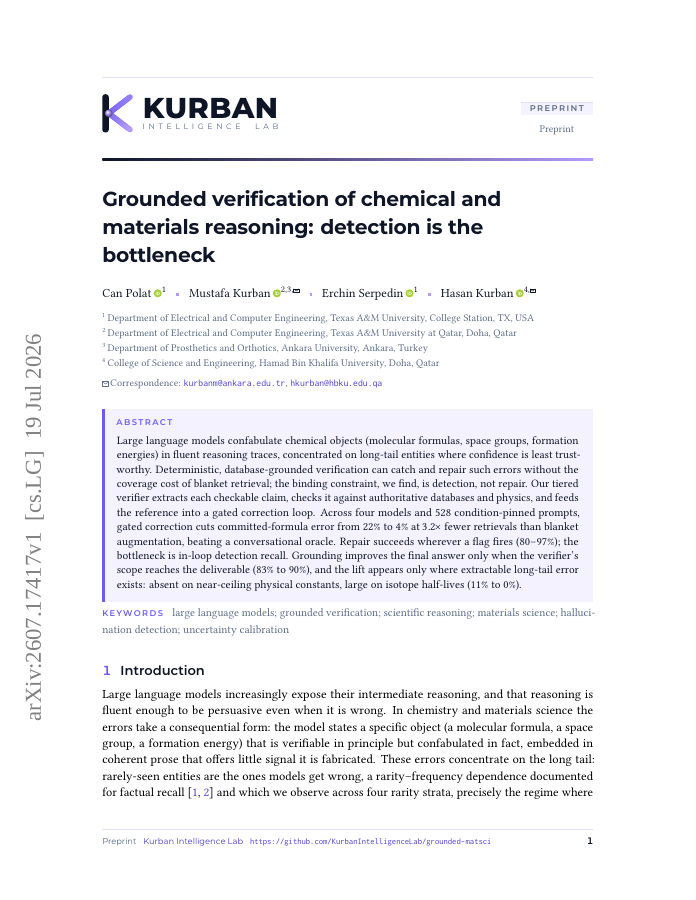
Large language models confabulate chemical objects (molecular formulas, space groups, formation energies) in fluent reasoning traces, concentrated on long-tail entities where confidence is least trustworthy. Deterministic, database-grounded verification can catch and repair such errors without the coverage cost of blanket retrieval; the binding constraint, we find, is detection, not repair. Our tiered verifier extracts each checkable claim, checks it against authoritative databases and physics, and feeds the reference into a gated correction loop. Across four models and 528 condition-pinned prompts, gated correction cuts committed-formula error from 22% to 4% at 3.2\times fewer retrievals than blanket augmentation, beating a conversational oracle. Repair succeeds wherever a flag fires (80--97%); the bottleneck is in-loop detection recall. Grounding improves the final answer only when the verifier's scope reaches the deliverable (83% to 90%), and the lift appears only where extractable long-tail error exists: absent on near-ceiling physical constants, large on isotope half-lives (11% to 0%).
Grounded verification of chemical and materials reasoning: detection is the bottleneck
Large language models confabulate chemical objects (molecular formulas, space groups, formation energies) in fluent reasoning traces, concentrated on long-tail entities where confidence is least trustworthy.
- Preview
- Year
- 2026
- Hosting
- Full text hostedCC-BY-4.0
Cite
Notes
Only stored in your browser.
Attribution
- Abstract & full text
- arxiv.org/abs/2607.17417CC-BY-4.0
- TL;DR
- Semantic Scholar