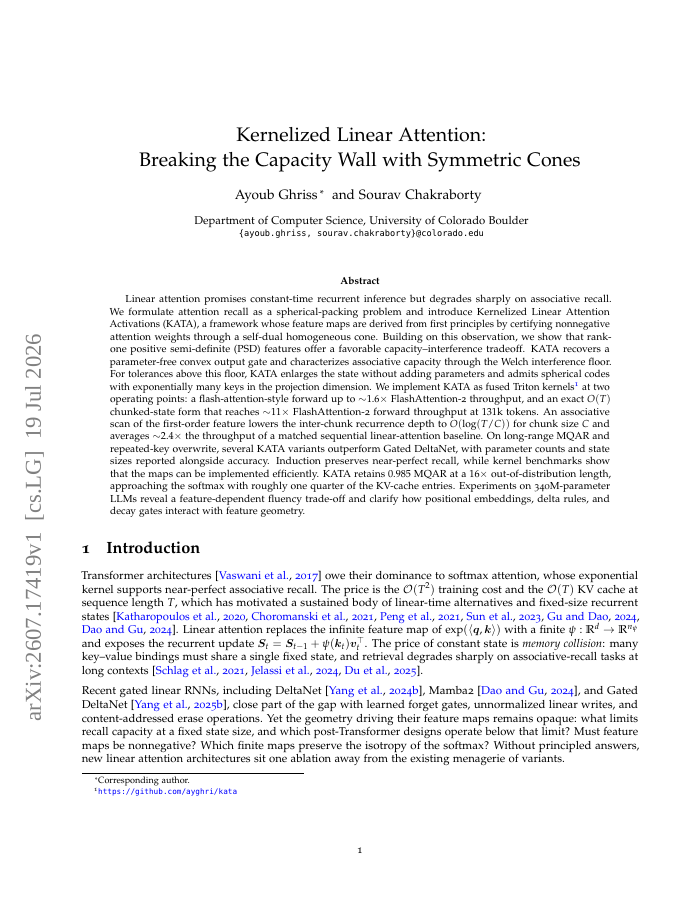
Linear attention promises constant-time recurrent inference but degrades sharply on associative recall. We formulate attention recall as a spherical-packing problem and introduce Kernelized Linear Attention Activations (KATA), a framework whose feature maps are derived from first principles by certifying nonnegative attention weights through a self-dual homogeneous cone. Building on this observation, we show that rank-one positive semi-definite (PSD) features offer a favorable capacity--interference tradeoff. KATA recovers a parameter-free convex output gate and characterizes associative capacity through the Welch interference floor. For tolerances above this floor, KATA enlarges the state without adding parameters and admits spherical codes with exponentially many keys in the projection dimension. We implement KATA as fused Triton kernels at two operating points: a flash-attention-style forward up to {\sim}1.6\times FlashAttention-2 throughput, and an exact O(T) chunked-state form that reaches {\sim}11\times FlashAttention-2 forward throughput at 131k tokens. An associative scan of the first-order feature lowers the inter-chunk recurrence depth to O(\log(T/C)) for chunk size C and averages {\sim}2.4\times the throughput of a matched sequential linear-attention baseline. On long-range MQAR and repeated-key overwrite, several KATA variants outperform Gated DeltaNet, with parameter counts and state sizes reported alongside accuracy. Induction preserves near-perfect recall, while kernel benchmarks show that the maps can be implemented efficiently. KATA retains 0.985 MQAR at a 16\times out-of-distribution length, approaching the softmax with roughly one quarter of the KV-cache entries. Experiments on 340M-parameter LLMs reveal a feature-dependent fluency trade-off and clarify how positional embeddings, delta rules, and decay gates interact with feature geometry.
Kernelized Linear Attention: Breaking the Capacity Wall with Symmetric Cones
Linear attention promises constant-time recurrent inference but degrades sharply on associative recall. We formulate attention recall as a spherical-packing problem and introduce Kernelized Linear Attention Activations (KATA), a framework whose feature maps are derived from…
- Preview
- Year
- 2026
- Hosting
- Full text hostedCC-BY-4.0
Cite
Notes
Only stored in your browser.
Attribution
- Abstract & full text
- arxiv.org/abs/2607.17419CC-BY-4.0
- TL;DR
- Semantic Scholar