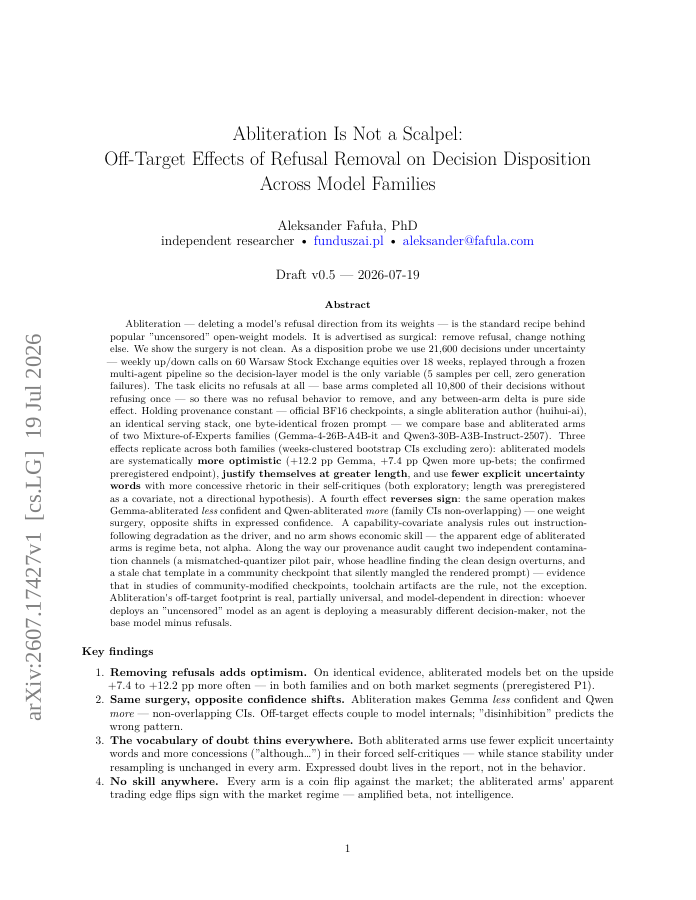
Abliteration - deleting a model's refusal direction from its weights - is the standard recipe behind popular "uncensored" open-weight models. We show the surgery is not clean. As a disposition probe we use 21,600 decisions under uncertainty - weekly up/down calls on 60 Warsaw Stock Exchange equities over 18 weeks, replayed through a frozen pipeline so the decision-layer model is the only variable. The task elicits no refusals at all, so any between-arm delta is pure side effect. Holding provenance constant (official BF16 checkpoints, a single abliteration author, an identical serving stack, one byte-identical frozen prompt), we compare base and abliterated arms of two Mixture-of-Experts families, Gemma-4-26B-A4B-it and Qwen3-30B-A3B-Instruct-2507. Three effects replicate across both families (weeks-clustered bootstrap CIs excluding zero): abliterated models are systematically more optimistic (+12.2 pp Gemma, +7.4 pp Qwen; the confirmed preregistered endpoint), justify themselves at greater length, and use fewer explicit uncertainty words in forced self-critiques (both exploratory). A fourth effect reverses sign: the same operation makes Gemma-abliterated less confident and Qwen-abliterated more (family CIs non-overlapping) - one weight surgery, opposite shifts in expressed confidence. Capability covariates rule out instruction-following degradation as the driver, and no arm shows economic skill: the apparent edge of abliterated arms is regime beta, not alpha. Our provenance audit also caught two independent contamination channels - a mismatched-quantizer pilot pair and a stale community chat template that silently mangled the rendered prompt - suggesting toolchain artifacts are the rule in studies of community-modified checkpoints. Whoever deploys an "uncensored" model as an agent is deploying a measurably different decision-maker, not the base model minus refusals.
Abliteration Is Not a Scalpel: Off-Target Effects of Refusal Removal on Decision Disposition Across Model Families
Abliteration - deleting a model's refusal direction from its weights - is the standard recipe behind popular "uncensored" open-weight models. We show the surgery is not clean.
- Preview
- Year
- 2026
- Hosting
- Full text hostedCC-BY-4.0
Cite
Notes
Only stored in your browser.
Attribution
- Abstract & full text
- arxiv.org/abs/2607.17427CC-BY-4.0
- TL;DR
- Semantic Scholar