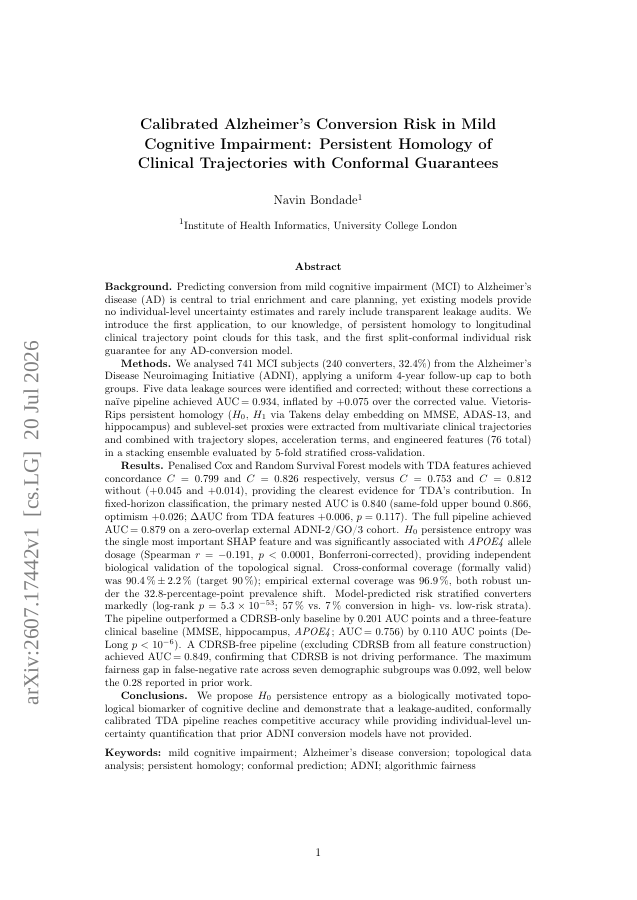
Background. Predicting conversion from mild cognitive impairment (MCI) to Alzheimer's disease (AD) is central to trial enrichment and care planning, yet existing models provide no individual-level uncertainty estimates and rarely include transparent leakage audits. We introduce the first application of persistent homology to longitudinal clinical trajectory point clouds for this task, and the first split-conformal individual risk guarantee for any AD-conversion model. Methods. We analysed 741 MCI subjects (240 converters, 32.4%) from ADNI with a uniform 4-year follow-up cap. Five leakage sources were corrected; without them a naive pipeline achieved AUC=0.934, inflated by +0.075. Vietoris-Rips persistent homology and sublevel-set proxies were combined with trajectory slopes and engineered features (76 total) in a stacking ensemble evaluated by 5-fold cross-validation. Results. Cox and Random Survival Forest models with TDA features achieved concordance C=0.799 and C=0.826 versus C=0.753 and C=0.812 without (+0.045 and +0.014). The primary nested AUC is 0.840 (same-fold bound 0.866); external AUC was 0.879 on a zero-overlap ADNI-2/GO/3 cohort. H0 persistence entropy was the top SHAP feature and significantly associated with APOE4 dosage (Spearman r=-0.191, p<0.0001, Bonferroni-corrected). Cross-conformal coverage was 90.4%+-2.2% (target 90%); empirical external coverage 96.9%. Maximum fairness gap in false-negative rate across seven subgroups was 0.092. Conclusions. We propose H0 persistence entropy as a topological biomarker of cognitive decline and demonstrate that a leakage-audited, conformally calibrated pipeline reaches competitive accuracy with individual-level uncertainty quantification not previously available for this task.
Calibrated Alzheimer's Conversion Risk in Mild Cognitive Impairment: Persistent Homology of Clinical Trajectories with Conformal Guarantees
Background. Predicting conversion from mild cognitive impairment (MCI) to Alzheimer's disease (AD) is central to trial enrichment and care planning, yet existing models provide no individual-level uncertainty estimates and rarely include transparent leakage audits.
- Preview
- Year
- 2026
- Hosting
- Full text hostedCC-BY-4.0
Cite
Notes
Only stored in your browser.
Attribution
- Abstract & full text
- arxiv.org/abs/2607.17442CC-BY-4.0
- TL;DR
- Semantic Scholar