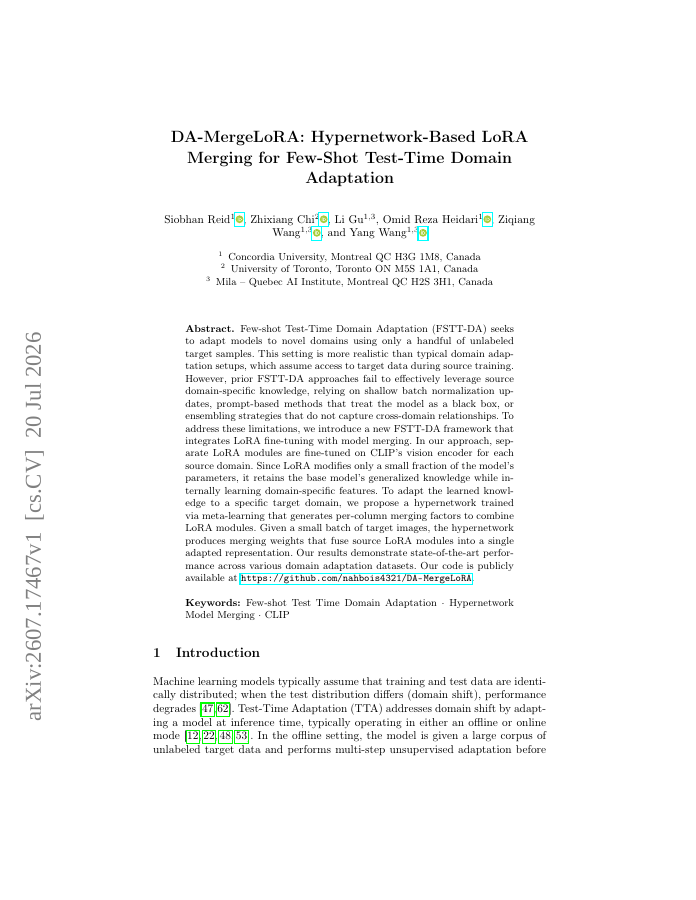
Few-shot Test-Time Domain Adaptation (FSTT-DA) seeks to adapt models to novel domains using only a handful of unlabeled target samples. This setting is more realistic than typical domain adaptation setups, which assume access to target data during source training. However, prior FSTT-DA approaches fail to effectively leverage source domain-specific knowledge, relying on shallow batch normalization updates, prompt-based methods that treat the model as a black box, or ensembling strategies that do not capture cross-domain relationships. To address these limitations, we introduce a new FSTT-DA framework that integrates LoRA fine-tuning with model merging. In our approach, separate LoRA modules are fine-tuned on CLIP's vision encoder for each source domain. Since LoRA modifies only a small fraction of the model's parameters, it retains the base model's generalized knowledge while internally learning domain-specific features. To adapt the learned knowledge to a specific target domain, we propose a hypernetwork trained via meta-learning that generates per-column merging factors to combine LoRA modules. Given a small batch of target images, the hypernetwork produces merging weights that fuse source LoRA modules into a single adapted representation. Our results demonstrate state-of-the-art performance across various domain adaptation datasets. Our code is publicly available at https://github.com/nahbois4321/DA-MergeLoRA.
DA-MergeLoRA: Hypernetwork-Based LoRA Merging for Few-Shot Test-Time Domain Adaptation
Few-shot Test-Time Domain Adaptation (FSTT-DA) seeks to adapt models to novel domains using only a handful of unlabeled target samples. This setting is more realistic than typical domain adaptation setups, which assume access to target data during source training.
- Preview
- Year
- 2026
- Hosting
- Full text hostedCC-BY-4.0
Cite
Notes
Only stored in your browser.
Attribution
- Abstract & full text
- arxiv.org/abs/2607.17467CC-BY-4.0
- TL;DR
- Semantic Scholar