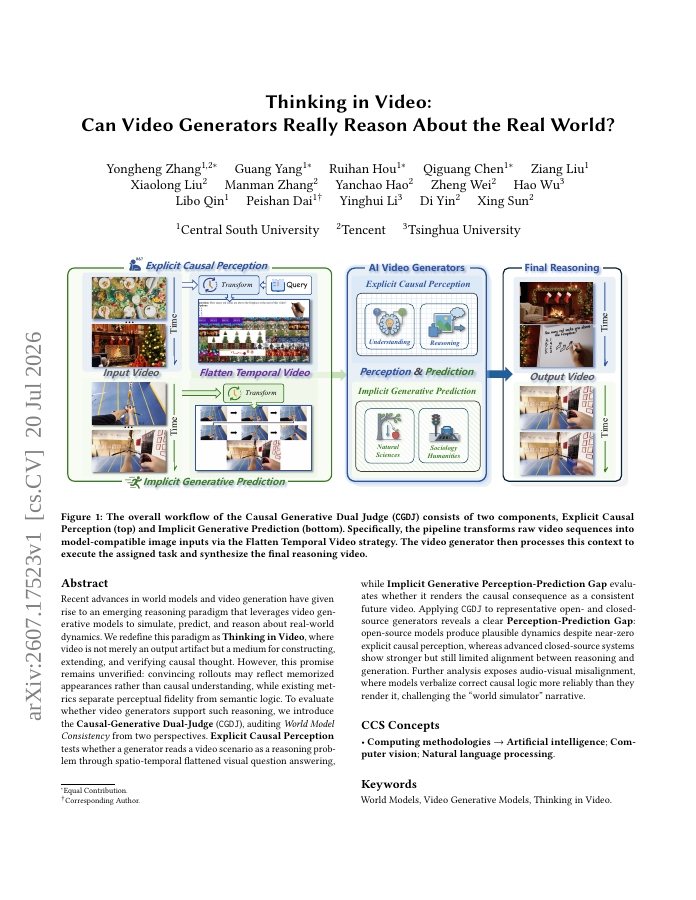
Recent advances in world models and video generation have given rise to an emerging reasoning paradigm that leverages video generative models to simulate, predict, and reason about real-world dynamics. We redefine this paradigm as Thinking in Video, where video is not merely an output artifact but a medium for constructing, extending, and verifying causal thought. However, this promise remains unverified: convincing rollouts may reflect memorized appearances rather than causal understanding, while existing metrics separate perceptual fidelity from semantic logic. To evaluate whether video generators support such reasoning, we introduce the Causal-Generative Dual-Judge (CGDJ), auditing World Model Consistency from two perspectives. Explicit Causal Perception tests whether a generator reads a video scenario as a reasoning problem through spatio-temporal flattened visual question answering, while Implicit Generative Perception-Prediction Gap evaluates whether it renders the causal consequence as a consistent future video. Applying CGDJ to representative open- and closed-source generators reveals a clear Perception-Prediction Gap: open-source models produce plausible dynamics despite near-zero explicit causal perception, whereas advanced closed-source systems show stronger but still limited alignment between reasoning and generation. Further analysis exposes audio-visual misalignment, where models verbalize correct causal logic more reliably than they render it, challenging the "world simulator" narrative.
Thinking in Video: Can Video Generators Really Reason About the Real World?
Recent advances in world models and video generation have given rise to an emerging reasoning paradigm that leverages video generative models to simulate, predict, and reason about real-world dynamics.
- Preview
- Year
- 2026
- Hosting
- Excerpt onlyCC-BY-NC-SA-4.0
Cite
Notes
Only stored in your browser.
Attribution
- Abstract & full text
- arxiv.org/abs/2607.17523CC-BY-NC-SA-4.0
- TL;DR
- Semantic Scholar