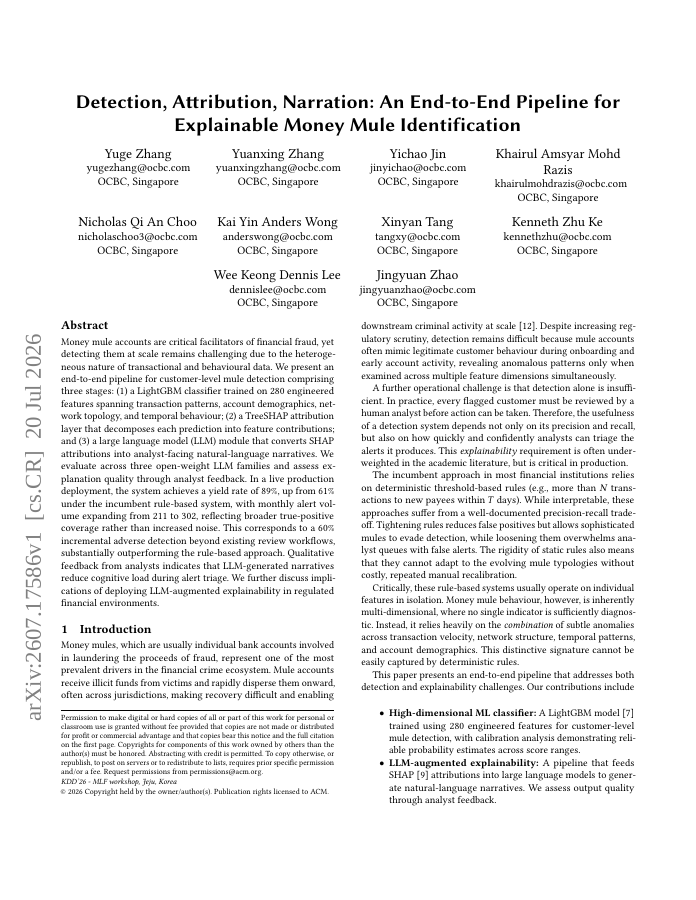
Money mule accounts are critical facilitators of financial fraud, yet detecting them at scale remains challenging due to the heterogeneous nature of transactional and behavioural data. We present an end-to-end pipeline for customer-level mule detection comprising three stages: (1) a LightGBM classifier trained on 280 engineered features spanning transaction patterns, account demographics, network topology, and temporal behaviour; (2) a TreeSHAP attribution layer that decomposes each prediction into feature contributions; and (3) a large language model (LLM) module that converts SHAP attributions into analyst-facing natural-language narratives. We evaluate across three open-weight LLM families and assess explanation quality through analyst feedback. In a live production deployment, the system achieves a yield rate of 89%, up from 61% under the incumbent rule-based system, with monthly alert volume expanding from 211 to 302, reflecting broader true-positive coverage rather than increased noise. This corresponds to a 60% incremental adverse detection beyond existing review workflows, substantially outperforming the rule-based approach. Qualitative feedback from analysts indicates that LLM-generated narratives reduce cognitive load during alert triage. We further discuss implications of deploying LLM-augmented explainability in regulated financial environments.
Detection, Attribution, Narration: An End-to-End Pipeline for Explainable Money Mule Identification
Money mule accounts are critical facilitators of financial fraud, yet detecting them at scale remains challenging due to the heterogeneous nature of transactional and behavioural data.
- Preview
- Year
- 2026
- Hosting
- Full text hostedCC-BY-4.0
Cite
Notes
Only stored in your browser.
Attribution
- Abstract & full text
- arxiv.org/abs/2607.17586CC-BY-4.0
- TL;DR
- Semantic Scholar