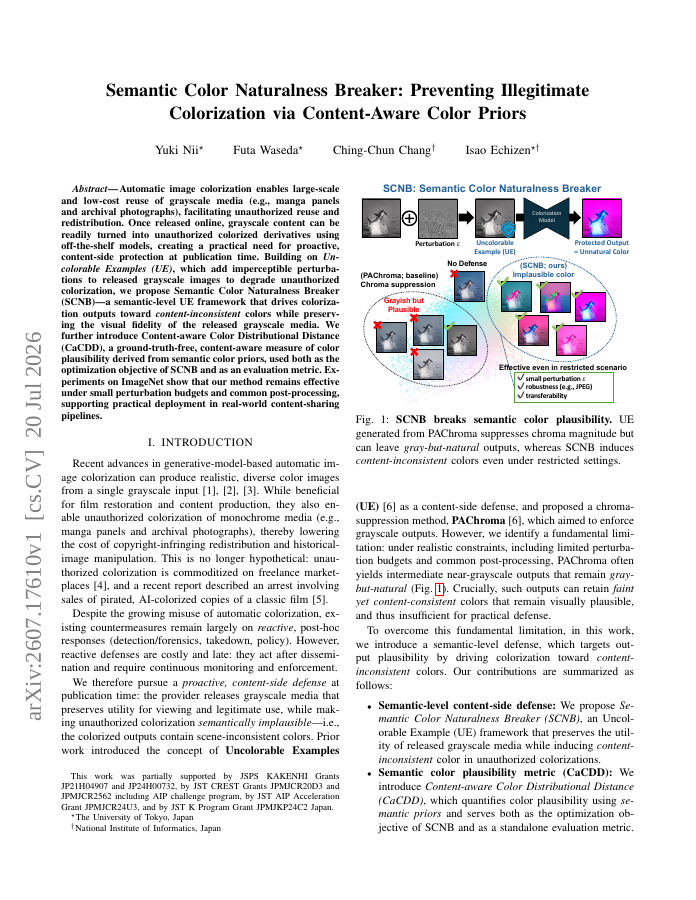
Automatic image colorization enables large-scale and low-cost reuse of grayscale media (e.g., manga panels and archival photographs), facilitating unauthorized reuse and redistribution. Once released online, grayscale content can be readily turned into unauthorized colorized derivatives using off-the-shelf models, creating a practical need for proactive, content-side protection at publication time. Building on Uncolorable Examples (UE), which add imperceptible perturbations to released grayscale images to degrade unauthorized colorization, we propose Semantic Color Naturalness Breaker (SCNB) -- a semantic-level UE framework that drives colorization outputs toward content-inconsistent colors while preserving the visual fidelity of the released grayscale media. We further introduce Content-aware Color Distributional Distance (CaCDD), a ground-truth-free, content-aware measure of color plausibility derived from semantic color priors, used both as the optimization objective of SCNB and as an evaluation metric. Experiments on ImageNet show that our method remains effective under small perturbation budgets and common post-processing, supporting practical deployment in real-world content-sharing pipelines.
Semantic Color Naturalness Breaker: Preventing Illegitimate Colorization via Content-Aware Color Priors
Automatic image colorization enables large-scale and low-cost reuse of grayscale media (e.g., manga panels and archival photographs), facilitating unauthorized reuse and redistribution.
- Preview
- Year
- 2026
- Hosting
- Full text hostedCC-BY-SA-4.0
Cite
Notes
Only stored in your browser.
Attribution
- Abstract & full text
- arxiv.org/abs/2607.17610CC-BY-SA-4.0
- TL;DR
- Semantic Scholar