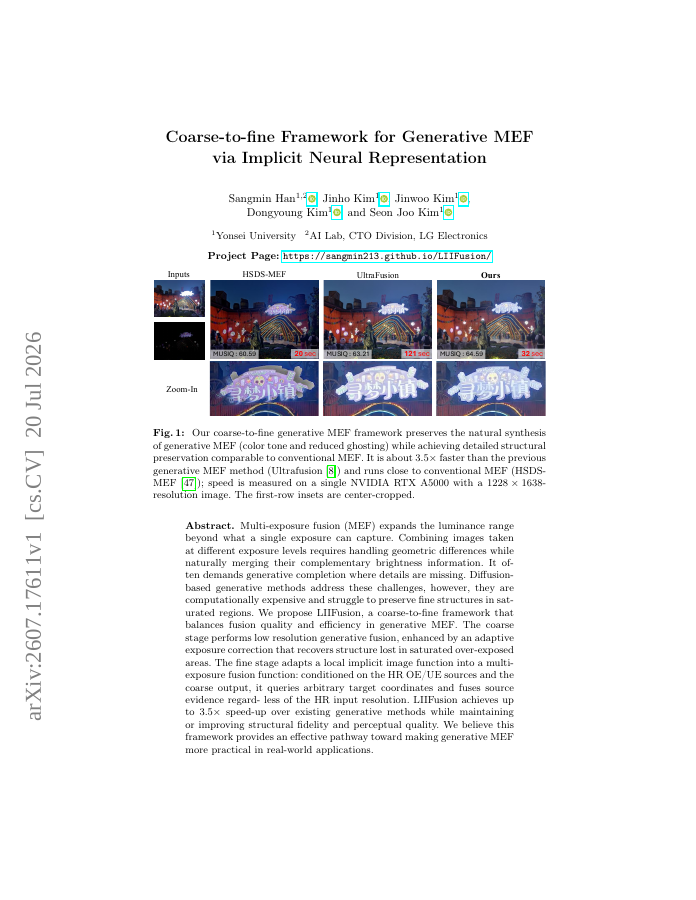
Multi-exposure fusion (MEF) expands the luminance range beyond what a single exposure can capture. Combining images taken at different exposure levels requires handling geometric differences while naturally merging their complementary brightness information. It often demands generative completion where details are missing. Diffusion-based generative methods address these challenges, however, they are computationally expensive and struggle to preserve fine structures in saturated regions. We propose LIIFusion, a coarse-to-fine framework that balances fusion quality and efficiency in generative MEF. The coarse stage performs low resolution generative fusion, enhanced by an adaptive exposure correction that recovers structure lost in saturated over-exposed areas. The fine stage adapts a local implicit image function into a multi-exposure fusion function: conditioned on the HR OE/UE sources and the coarse output, it queries arbitrary target coordinates and fuses source evidence regardless of the HR input resolution. LIIFusion achieves up to 3.5\times speed-up over existing generative methods while maintaining or improving structural fidelity and perceptual quality. We believe this framework provides an effective pathway toward making generative MEF more practical in real-world applications.
Coarse-to-fine Framework for Generative MEF via Implicit Neural Representation
Multi-exposure fusion (MEF) expands the luminance range beyond what a single exposure can capture. Combining images taken at different exposure levels requires handling geometric differences while naturally merging their complementary brightness information.
- Preview
- Year
- 2026
- Hosting
- Excerpt onlyCC-BY-NC-SA-4.0
Cite
Notes
Only stored in your browser.
Attribution
- Abstract & full text
- arxiv.org/abs/2607.17611CC-BY-NC-SA-4.0
- TL;DR
- Semantic Scholar