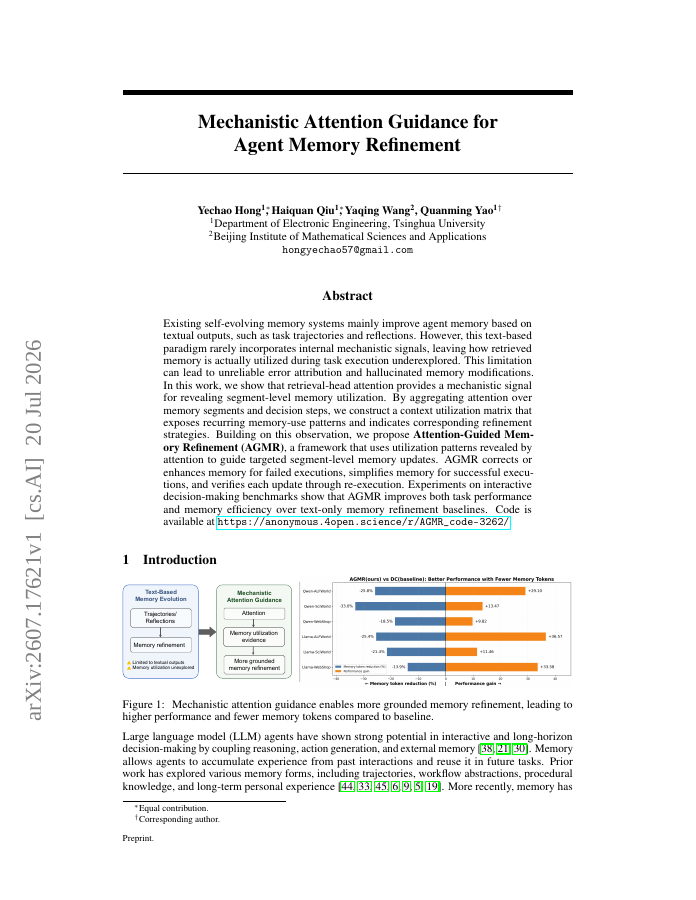
Existing self-evolving memory systems mainly improve agent memory based on textual outputs, such as task trajectories and reflections. However, this text-based paradigm rarely incorporates internal mechanistic signals, leaving how retrieved memory is actually utilized during task execution underexplored. This limitation can lead to unreliable error attribution and hallucinated memory modifications. In this work, we show that retrieval-head attention provides a mechanistic signal for revealing segment-level memory utilization. By aggregating attention over memory segments and decision steps, we construct a context utilization matrix that exposes recurring memory-use patterns and indicates corresponding refinement strategies. Building on this observation, we propose Attention-Guided Memory Refinement (AGMR), a framework that uses utilization patterns revealed by attention to guide targeted segment-level memory updates. AGMR corrects or enhances memory for failed executions, simplifies memory for successful executions, and verifies each update through re-execution. Experiments on interactive decision-making benchmarks show that AGMR improves both task performance and memory efficiency over text-only memory refinement baselines. Code is available at https://anonymous.4open.science/r/AGMR_code-3262/
Mechanistic Attention Guidance for Agent Memory Refinement
Existing self-evolving memory systems mainly improve agent memory based on textual outputs, such as task trajectories and reflections. However, this text-based paradigm rarely incorporates internal mechanistic signals, leaving how retrieved memory is actually utilized during…
- Preview
- Year
- 2026
- Hosting
- Abstract onlyARXIV-DEFAULT
Cite
Notes
Only stored in your browser.
Attribution
- Abstract & full text
- arxiv.org/abs/2607.17621ARXIV-DEFAULT
- TL;DR
- Semantic Scholar