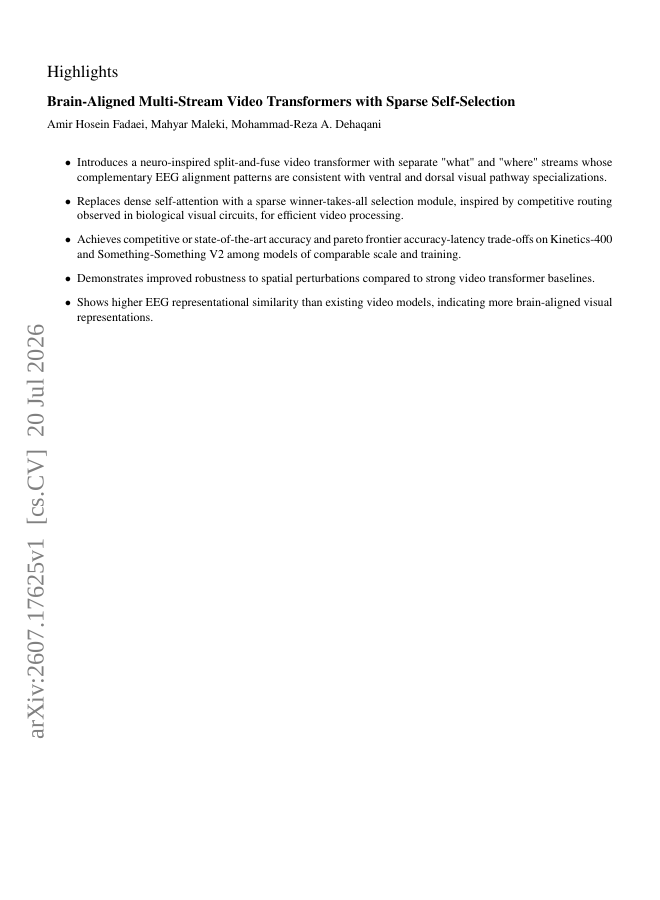
Modern video transformers typically ignore principles from primate vision and are rarely evaluated against neural data, limiting their biological interpretability. We introduce a sparse winner-takes-all token selection module that replaces dense self-attention to improve efficiency and approximate competitive routing observed in biological visual circuits. We further propose a neuro-inspired split-and-fuse video transformer which uses two complementary pathways: a high-resolution, low-frame-rate "what" stream and a low-resolution, high-frame-rate "where" stream, fused before classification. On Kinetics-400 and Something-Something V2, our best variant operates on the Pareto frontier of accuracy versus inference time among models of comparable scale and pretraining, and showing improved robustness to spatial perturbations. Using representational similarity analysis between model embeddings and time-resolved EEG recordings for the same video stimuli, our model attains a peak brain-model correlation of 0.18 (about 78% of the noise ceiling) and consistently outperforms strong video transformer baselines, suggesting that pathway specialization and sparse competition are useful inductive biases for efficient, brain-aligned video understanding.
Brain-Aligned Multi-Stream Video Transformers with Sparse Self-Selection
Modern video transformers typically ignore principles from primate vision and are rarely evaluated against neural data, limiting their biological interpretability. We introduce a sparse winner-takes-all token selection module that replaces dense self-attention to improve…
- Preview
- Year
- 2026
- Hosting
- Abstract onlyARXIV-DEFAULT
Cite
Notes
Only stored in your browser.
Attribution
- Abstract & full text
- arxiv.org/abs/2607.17625ARXIV-DEFAULT
- TL;DR
- Semantic Scholar