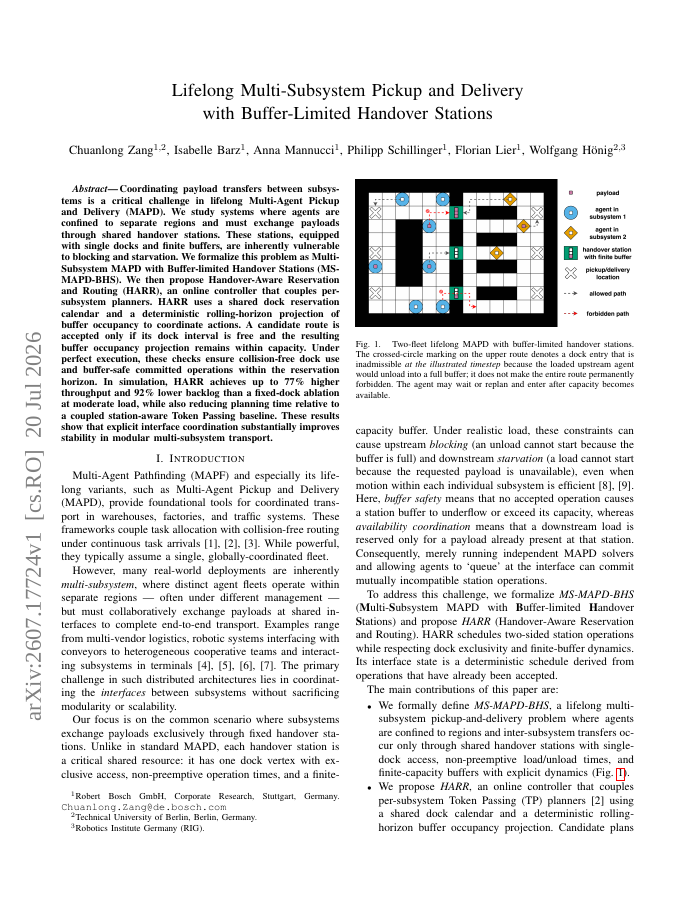
Coordinating payload transfers between subsystems is a critical challenge in lifelong Multi-Agent Pickup and Delivery (MAPD). We study systems where agents are confined to separate regions and must exchange payloads through shared handover stations. These stations, equipped with single docks and finite buffers, are inherently vulnerable to blocking and starvation. We formalize this problem as Multi-Subsystem MAPD with Buffer-limited Handover Stations (MS-MAPD-BHS). We then propose Handover-Aware Reservation and Routing (HARR), an online controller that couples per-subsystem planners. HARR uses a shared dock reservation calendar and a deterministic rolling-horizon projection of buffer occupancy to coordinate actions. A candidate route is accepted only if its dock interval is free and the resulting buffer occupancy projection remains within capacity. Under perfect execution, these checks ensure collision-free dock use and buffer-safe committed operations within the reservation horizon. In simulation, HARR achieves up to 77% higher throughput and 92% lower backlog than a fixed-dock ablation at moderate load, while also reducing planning time relative to a coupled station-aware Token Passing baseline. These results show that explicit interface coordination substantially improves stability in modular multi-subsystem transport.
Lifelong Multi-Subsystem Pickup and Delivery with Buffer-Limited Handover Stations
Coordinating payload transfers between subsystems is a critical challenge in lifelong Multi-Agent Pickup and Delivery (MAPD). We study systems where agents are confined to separate regions and must exchange payloads through shared handover stations.
- Preview
- Year
- 2026
- Hosting
- Abstract onlyARXIV-DEFAULT
Cite
Notes
Only stored in your browser.
Attribution
- Abstract & full text
- arxiv.org/abs/2607.17724ARXIV-DEFAULT
- TL;DR
- Semantic Scholar